Home & Garden
8 Plumbing Warning Signs You Should Never Ignore

Most plumbing faults give notice before they turn into emergencies. The notice is easy to miss, because it arrives as small things: a drain that empties a little slower, a tap that drips a little longer, a water bill that sits a little higher than the month before. On their own these read as minor annoyances. Together they are usually a system under strain. The eight signs below are the ones worth acting on, and the pattern they form matters as much as any single item.
Slow drains that keep getting slower
A drain that occasionally empties slowly is often nothing. One that gets slower each week is a different matter. When more than one fixture backs up, or when a plunger clears a blockage only for it to return within days, the cause is usually further down the line than the fixture trap. That kind of buildup does not resolve itself. It accumulates until the pipe is fully blocked.
Gurgling and banging in the pipes
Pipes make noise when air or water moves through them in a way the system was not designed for. A gurgling drain means air is being forced through standing water, which usually points to a partial blockage further along the pipe. A banging pipe, often called water hammer, happens when a valve closes suddenly and the momentum of the water makes the pipe knock against its fittings. Both conditions tend to get worse, because they are symptoms of a problem that is already there.
Drips that never quite stop
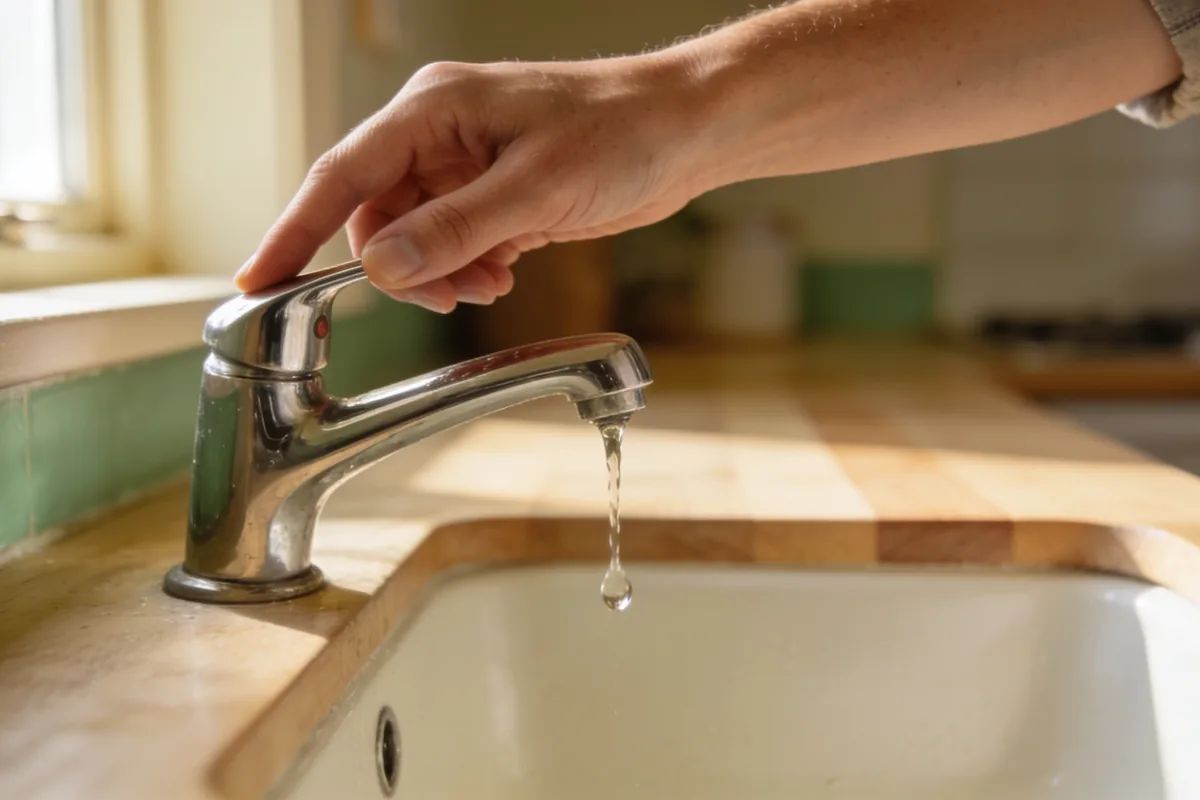
A tap that drips continuously is a leak you can see, and it is the easiest sign on this list to postpone. The drip itself is the washer or valve failing, and leaving it means the leak works its way into the tap body and the fitting behind the wall. What starts as a replacement washer can become a worn valve or a corroded thread. The repair is cheaper at the drip stage than at the stage where the whole tap has to be replaced.
Water pressure that drops suddenly
When the pressure falls at every tap and shower at the same time, the cause is upstream of the house: a leak in the supply line, a failing pressure valve or buildup inside the main pipe. When only one fixture is affected, the problem is usually in that fixture or its own supply line. A sudden drop is worth treating as urgent, because a supply line leak wastes water continuously and can damage the ground around the pipe before it shows anywhere else.
Drain odours that keep coming back
Household drains hold a water seal that stops sewer gas rising into the room. When that seal is lost, or when the vent pipe is blocked, the smell returns no matter how often the drain is cleaned. Odours that persist after cleaning usually mean the problem is in the pipe or the venting rather than at the surface of the drain. Pouring more cleaner down will not restore a broken seal.
Water stains and damp patches
Stains on a ceiling, wall or cabinet base are the visible end of a leak that has been running for a while. Damp plaster, peeling paint and skirting boards that warp all point the same way. The leak itself can be some distance from the stain, because water runs along the top of a ceiling or the inside of a wall before it shows. Tracing it usually means following the water back to its source rather than painting over the mark.
Toilets that keep running or blocking
A toilet that runs on after flushing is passing water continuously, and a running toilet is one of the most common reasons a bill climbs without any change in habits. A toilet that rocks at the base or blocks repeatedly points beyond the pan, usually to the waste pipe or the seal at the floor. Both are the kind of problem that quietly gets worse.
A water bill that rises for no reason
The most reliable sign is also the least visible. When a household’s habits have not changed and the bill climbs anyway, water is leaving the property somewhere it should not. Taps, toilets, the hot water system and the supply line are the usual candidates. A simple check is to read the meter, use no water for an hour and see whether the meter still moves. If it does, water is passing somewhere between the street and the house.
Why these signs matter more than they seem
Every item on this list is a small problem at first and a larger one later. A slow drain becomes a blocked line, a running toilet wastes water month after month, and a damp patch left in place can damage framing and encourage mould. The reason to act early is practical. Plumbing sits inside walls, under floors and below the garden, so the damage from a leak is usually well advanced by the time it becomes visible. Replacing a small part while the problem is still small costs less than repairing the damage the leak causes afterwards.
The smallest leak is the cheapest to fix
The signs on this list rarely stay single for long. When two or three of them appear together, or when one keeps returning after a repair, the cause is probably in the system rather than in one fixture. That is the point at which a licensed plumber earns the call, because they can find the source, quote for the repair and fix it in a single visit. Acting on the small signs is not an overreaction. It is the difference between a minor repair and a major one.