Eco Friendly
Composting at Home in Australia: What Goes in the Bin and What Doesn’t

The short version
- Greens and browns, roughly equal. Wet kitchen scraps and grass need dry leaves, paper and cardboard to balance them; that balance is what stops the smell.
- Keep meat, fish and dairy out of an open bin. They rot, smell and attract pests; some enclosed systems have their own rules.
- Finished compost is dark, crumbly and smells like earth. Dig it into garden beds or use it as mulch, and check your council for what its own bin accepts.
The first handful of scraps going into a new compost bin is a small act with a slightly nervous audience. You stand there with a bucket of vegetable peelings, wondering if you are about to create something that smells, attracts flies and annoys the neighbours. That worry stops most people before they start. Here is the reassurance: composting is a balance, not a science, the do-and-do-not list is shorter than people fear, and once it is running, a compost bin is the quietest, most satisfying corner of the garden.
Check it before it goes in
Not sure about something in your hand, or what the bin is telling you? Two quick questions give one plain answer. This is for an open backyard bin.
If this does not load: the yes list is fruit and vegetable scraps, eggshells, tea bags, coffee grounds and garden waste. The no list for an open bin is meat, fish, dairy, cooked food, diseased plants, weeds gone to seed, and treated or glossy paper.
The balance in one line: greens and browns, roughly equal, with air, moisture and time. Finished compost is dark, crumbly and smells like earth.
This is for an open backyard bin. Worm farms and council green (FOGO) collections have their own rules.
What composting actually is
Composting is the controlled breakdown of organic matter into a soil-like material. Bacteria, fungi and insects do the work, turning kitchen and garden waste into something dark and crumbly that plants love. It is the same rotting that happens on a forest floor, just gathered into one place and given the right conditions to happen faster.
The value is in what it produces. The dark material at the end holds the nutrients plants need, and it improves soil structure by helping the ground hold water and air. Gardeners have their own name for it for a reason, and it costs nothing but the scraps you would otherwise throw out.
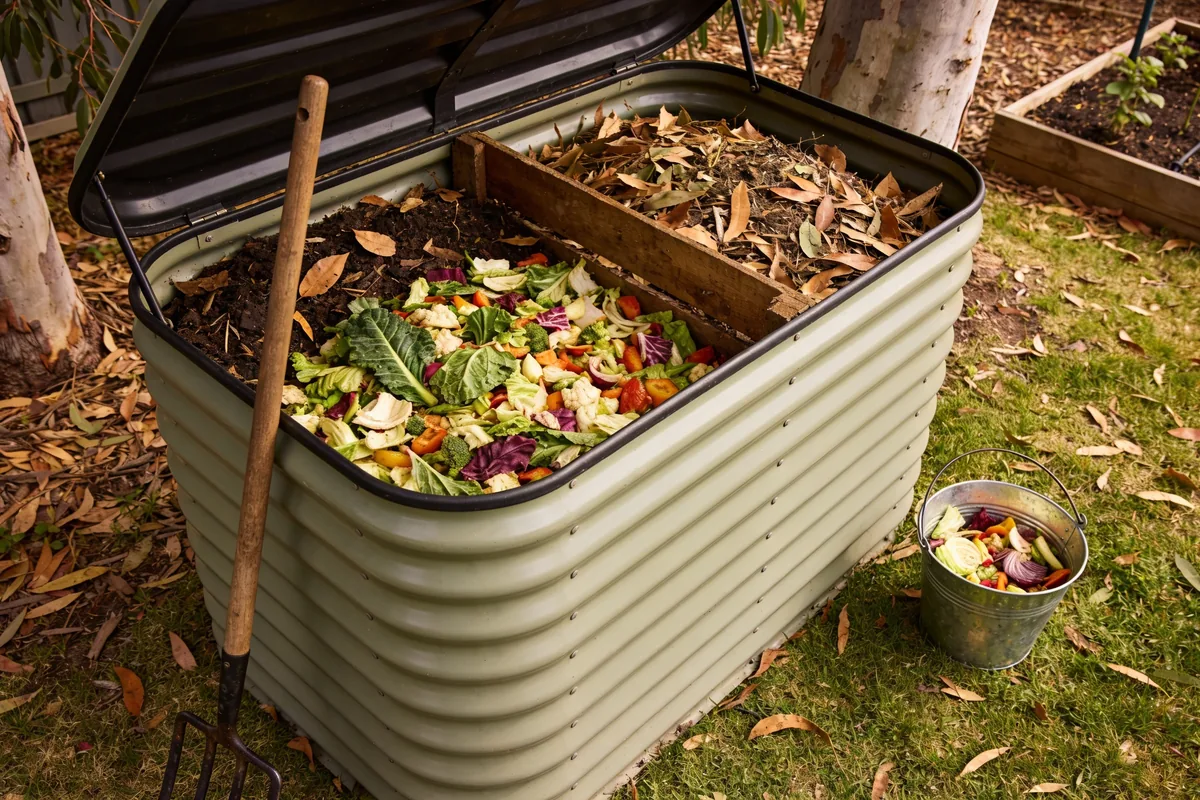
In Australia, household composting takes a few common forms. A compost bin or heap is the classic version, a place in the garden where scraps and garden waste break down together. A worm farm uses worms to do the work, and it is a different system with different rules, better suited to small spaces and smaller volumes. And many councils now run a green or organics collection, often called FOGO, which takes food and garden waste away for composting at scale. This article focuses on a home compost bin or heap. The yes and no lists below are for that open bin, and a worm farm or a council FOGO bin may have different rules, so check the system you are using.
There is a wider point that sits behind all of it. Food waste is a large share of what Australian households throw out, and composting is the easiest way to turn a chunk of it into something useful instead of landfill. It is the same instinct that drives the site’s guide to going plastic free at home, one more habit in the lower-waste household, and it is one of the most forgiving to start.
What goes in (the yes list)
The yes list is friendly and familiar, because it is mostly the stuff you already throw away. Fruit and vegetable scraps go in, the peelings, the cores, the ends you cut off. Eggshells go in. Tea bags and coffee grounds go in. And garden waste goes in, leaves, grass clippings and small prunings.
Chopped-up scraps break down faster than whole ones, so a rough chop helps, but it is not a requirement. The bin does not care whether you diced the carrot or threw it in whole. It simply takes longer.
The mental shift for most people is realising how much of the kitchen waste stream belongs in the bin. Once the yes list is in your head, the bucket by the sink stops being a chore and starts being the first step of a process that ends in the garden.
A note on volume while you are at it: most kitchen scraps are wet and count as greens, so a household that adds a lot of fruit and vegetable waste needs the dry browns to keep up. A bag of shredded paper or a pile of autumn leaves kept beside the bin makes the balance easy to reach on a wet week.
What stays out (the no list)
The no list for an open backyard bin is shorter, and it exists for one reason: some things rot in a way that smells and draws pests. Meat, fish, dairy and cooked food are the big ones. In an open bin they go rancid, smell and attract flies and rodents, and they turn the bin from a quiet corner of the garden into a problem. Keep them out.
Diseased plants and weeds that have gone to seed should stay out too, because a backyard bin does not get hot enough to reliably kill disease or weed seeds, and you do not want to spread either when you use the compost. Treated or glossy paper is out as well, because the coatings do not break down the way plain paper and cardboard do.
None of this is complicated, and the note that comes with it matters: some enclosed composters and worm farms have different rules. A worm farm, for example, has its own list of what the worms can and cannot handle. Check the guidance for the system you have, rather than assuming one list fits all.
The balance that stops the smell
The core practical lesson, and the one that prevents almost every problem, is the balance between greens and browns. Roughly equal parts, by volume, of each.
Greens are the wet, nitrogen-rich stuff: kitchen scraps and fresh grass clippings. Browns are the dry, carbon-rich stuff: dry leaves, plain paper, cardboard and straw. A compost needs both. The greens feed the bacteria that do the breaking down; the browns soak up moisture, add air and stop the greens from turning into a wet, stinking sludge.
Here is the diagnostic that makes the whole thing easy to manage. A compost that smells is usually too wet or too heavy on greens, so add more browns, dry leaves, torn cardboard, and turn it to let air in. A compost that is attracting flies or rodents is usually getting the wrong things or is left uncovered, so check what has gone in and keep a lid or a layer of browns on top. Turning the pile occasionally adds air, and air is the other ingredient in the balance.
The two most common problems have the same shape. A bin that smells like rotting eggs is short of air and heavy on moisture, so turn it and add dry browns. A bin that is dry and barely breaking down needs water or more green material. You are balancing the same two dials the whole time, moisture and air, and the fix is almost always more browns or a turn.
Where to put it and how to look after it
Siting the bin is simpler than it looks. Put it in part shade if you can, which stops it drying out in summer. Stand it on soil or gravel rather than paving, so drainage and worms can move through. And put it somewhere convenient to the kitchen, because the bin you have to walk past the whole garden to reach is the bin that does not get used.
A working compost is not a fast process. It is usually months rather than weeks before the material is ready, and the honest expectation saves a lot of unnecessary poking. In the meantime, a few small habits keep it healthy. If it is too wet, add browns and turn it. If it is too dry, which happens in Australian summers, add water or more wet greens. If it smells, you already know the fix.
The bin does not demand much. A minute of attention every few days, a turn when you think of it, and the process looks after itself. The patience is the hard part, because for the first few weeks it looks like nothing is happening. Under the surface, it is.
If you are setting up a bin for the first time, begin with a layer of coarse material, small branches or dry stalks, at the bottom to let air in, then build in layers of greens and browns as the scraps arrive. A bin that starts with air at the base and balance in the middle looks after itself from the first week.
What to do with the finished compost
The reward arrives when the compost is dark, crumbly and smells like earth rather than rot. That is the sign it is done. Dig it into garden beds before planting, spread it as mulch around established plants, or mix it into potting mix for pots. It is the best free soil conditioner a gardener can get, and it came from the peelings you would have thrown out.
Finished compost is the argument for growing real plants rather than artificial ones, and the site’s guide to real versus artificial plants weighs that choice honestly. The compost feeds the soil that feeds the plants, and it connects neatly to growing things you can eat, such as the herbs covered in the site’s windowsill herb garden guide.
One note before you use it everywhere: council rules vary on what can go in a home bin versus a FOGO collection, so check what your local council accepts if you are using its service as well. And if the compost is not quite ready, give it more time. Using it too early just means it carries on breaking down in the garden, which is not a disaster, but waiting for the crumbly stage is better.
Spread as mulch, compost also feeds the soil slowly as rain carries it down, and dug into beds it improves the structure for a season or more. It is one of the few garden inputs that does not cost money, which makes it the most satisfying thing you can add to a bed, because you watched it happen from the bucket under the sink.
The bin, done right
Composting is less a science than a simple balance: greens and browns, roughly equal, with air and moisture and time. The do-and-do-not list is shorter than people fear, and the smell-and-pests worry is really just the balance being off, which is fixable in a few minutes.
The reward is less rubbish and better soil, one scrap at a time. Start with a bucket by the sink and a bin in the shade, keep the meat out and the browns in, and let the bacteria do the work they have been doing for millions of years. The first time you dig dark, crumbly compost out of a bin that you built from peelings, you will wonder why the whole street is not doing it.
Sources: Sustainability Victoria, composting and food waste at home · NSW Environment Protection Authority, composting guidance · CSIRO, soil and compost science explainers