Home & Garden
Cabinet Hinges, Decoded: Overlay Types, the Cup Measurement and How to Match a Replacement

- Two families of hinge: concealed cup hinges, which hide inside the cabinet, and exposed hinges, which you can see. Almost every Australian kitchen built in the last thirty years uses the concealed kind.
- Three overlays: full, half and inset. The overlay is how much of the frame the closed door covers, and it is the thing people get wrong.
- Four things decide whether a replacement fits: the cup, the door thickness, the overlay the door needs, and the mounting plate.
- A hinge and its mounting plate are a matched pair, and they are ordered together.
- This is a twenty-minute job, not a new kitchen.
The hinge gives up on a Saturday, usually one of the two holding the door everyone uses most. The door drops a little, hangs crooked, and the household begins to treat it like a drawer without runners. What follows is not a new kitchen and not a new door. You are replacing one small part, and the part can be identified from the old one with a ruler, a few minutes and a photograph. What follows is how to work out what you have, measure the things that matter, and order the piece that screws back into the same holes. Most of the time.
The two families of hinge
Start with the simplest question: which family of hinge is on the door? There are two, and they barely resemble each other.
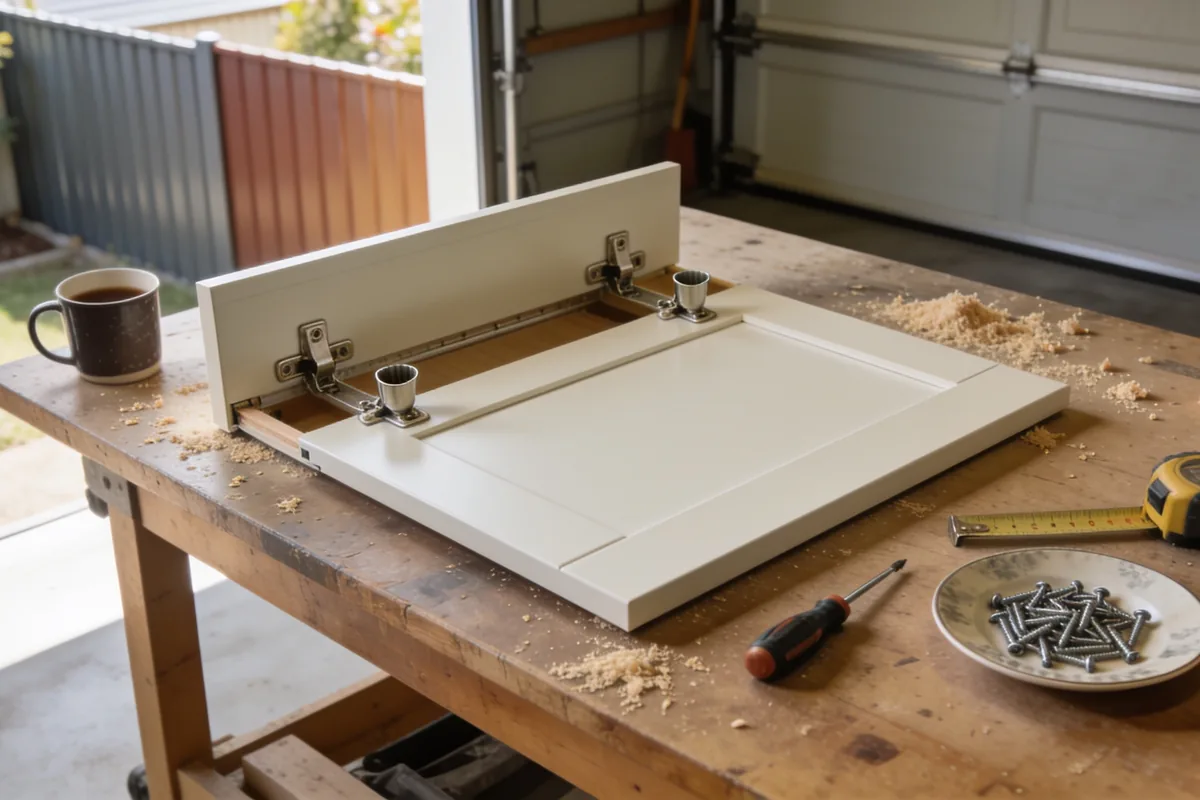
Concealed hinges, also called European cup hinges, sit inside the cabinet and disappear when the door is closed. The mechanism is in two pieces: a round housing, the cup, sunk into the inner face of the door, and an arm that reaches across to a mounting plate screwed to the cabinet’s side panel. Almost every Australian kitchen built in the last thirty years uses these, which is why a replacement is usually a standard part rather than a hunt through antique catalogues.
Exposed hinges, by contrast, are exactly that: visible when the door is shut. Butt hinges, face-frame hinges and the decorative kinds on period furniture all belong to this family, and they turn up on older and period cabinets.
Telling the two apart takes three seconds. Open the door and look at its inner face. If you see a metal cup sunk into the door with an arm reaching across to the cabinet, you have a concealed hinge. If the hinge is visible from the front while the door is shut, it is exposed. Everything in the rest of this article assumes the concealed kind, because that is what nearly every reader has.
The three overlays, which is the part everyone gets wrong
The overlay is how much of the cabinet frame the closed door covers, and it comes in three types.
A full overlay is what it sounds like: the door covers the entire cabinet opening, hiding the frame behind it. This is the standard arrangement on modern kitchens, and it applies to most single doors and to the outer doors of a pair.
A half overlay is the shared-divider arrangement, where two doors close against each other and each covers roughly half of the frame between them. This is the type people miss, because the door looks like a full overlay from the front until you measure how much frame is showing at the edge.
An inset door sits inside the opening, flush with the frame, like the doors on older dressers and quality joinery. It is the least common of the three in modern kitchens, and it takes a different mechanism from either overlay.
You do not need the vocabulary to get this right. You need to open the door and look at how much of the frame the closed door was covering: all of it, half of it, or none of it because the door sat inside. Write the answer down. When you order a replacement, the overlay is what the new hinge and plate have to reproduce, and getting it wrong is the commonest reason a door comes home and hangs crooked.
The measurements that decide whether the new hinge fits
This is the part to do at the bench, with the old hinge in front of you rather than in your hand at a shop.
The cup comes first: the diameter of the round housing sunk into the door, and the depth of the hole it sits in. There is a size that comes up again and again in Australian kitchens, and there are others, which is why the honest instruction is to measure yours rather than assume. A tape or a ruler across the cup gives the diameter; a matchstick pushed to the bottom of the bore, marked and measured, gives the depth. Write both down.
The door thickness comes next, because the cup bore and the door thickness have to be compatible. Cabinet doors vary more than people expect, and a thin door cannot take the same fitting as a thick one.
Then the overlay distance, using the test from the previous section. The arm’s crank, whether it is straight or offset, is what sets the overlay the hinge produces, which is why the overlay has to be known before the part is chosen.
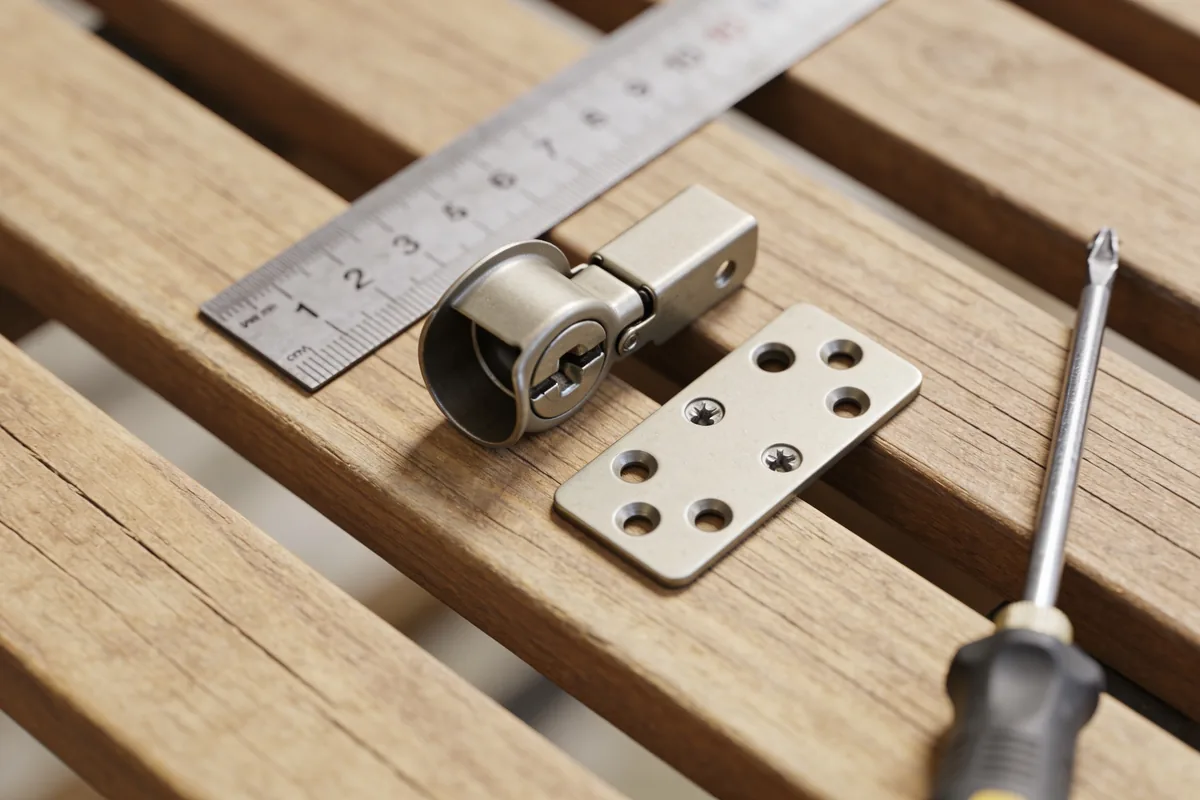
Last comes the mounting plate, the piece screwed to the cabinet’s side panel that the hinge arm clips onto. This is where most mismatches happen, and it is worth saying plainly: the hinge and the plate are a matched pair. They are designed to work together, they are ordered together, and a new hinge on an old plate is where people get caught a second time.
If you are matching a replacement to an old hinge, the plate and the arm are what you photograph alongside the cup. If you cannot find the plate, or the arm’s geometry looks unusual, that is the moment to take the whole assembly to someone who matches parts for a living.
Soft close, and whether you can retrofit it
Soft close is the damper that catches the door in the last part of its swing and brings it to the frame quietly instead of with a bang. It is built into some hinges, and added to others as a small clip-on piece. It is also the upgrade most people want once a door is off the cabinet anyway.
Can you retrofit it to what you have? Usually yes, and usually one of two ways: replace the hinge with a soft-close version of the same family and overlay, or add the damper to the hinge that is already there. Which of the two applies depends on the hinge you have, which is why the order of operations does not change: identify the hinge first, then ask whether the soft-close version or an add-on exists for it.
One honest note, kept brandless on purpose. Soft close on a budget hinge and soft close on a good one are not the same experience. The difference shows up over years and on heavy doors, and it is worth knowing that “soft close” on a price tag describes a feature, not a standard.
If you are ordering an add-on damper rather than a new hinge, the matching follows the same order of operations as the hinge itself: identify the family, the overlay and the arm, then ask for the damper made for that assembly. A damper that is close but not right will fit loosely, work badly, or fall off, and that is a worse door than the one you started with.
The traps, from people who have hit them
These are the situations that send people back to the shop, and each has an answer.
The first: the piece that popped out may not be a broken hinge at all. If a small plastic piece has come loose or fallen from the hinge, it may be a restrictor clip, the part that stops the door swinging too far. The hinge itself is often fine, and the clip can be reinstalled. Look at what came off before ordering anything.
The second: the screws may not line up even when the overlay matches. Screw-hole patterns differ between manufacturers and between eras, so a hinge can be functionally identical and still not use the same fixing points. This is the moment for a small trick: fill the old holes with a glued timber dowel, let it set, and drill fresh pilot holes. The plate goes back on the cabinet exactly where it needs to be, and the plate’s position is forgiving in a way the cup is not: a few millimetres either way, and the hinge’s own adjustment screws correct the rest of the alignment.
The third, and the one the older kitchen runs into: a cabinet from forty years ago will often match nothing on a shelf. The answer is not to keep hunting for an identical part. It is to move the mounting plate, or adjust the door, so that the nearest modern hinge can do the job. This is a drill and five minutes, and it solves what the catalogue cannot.
The fourth: stripped screw holes in chipboard. A bigger screw is not the fix; it splits the board. The reliable repairs are a glued dowel, a longer screw reaching sound material beside the hole, or a repair plate that spreads the load. All three are counter purchases, and all three work.
Drawer runners, in one short section
A kitchen repair rarely stops at one part, and the next one along is usually the runners, so here they are in brief.
There are two kinds. Side-mount runners screw to the sides of the drawer box and to the cabinet wall, and you can see them from the side when the drawer is out. Under-mount runners hide beneath the drawer, and give a cleaner look from above.
What to measure is the same shape of list as the hinge: the length of the runner and the depth of the cabinet it lives in, the dimensions of the drawer box itself, and the load the drawer is expected to carry. A drawer that carries heavy things wears its runners faster, and the load a runner is rated for is printed on the new packaging rather than on the old part, so check it when you match.
Then the matching trap, which is the same one as the hinge: runners are a matched system, so replacing one runner usually means replacing the pair. Order both sides at once.
It is the same kind of small fitting swap as a tap washer or a toilet cistern valve: fiddly until you know the part, quiet once it is done. The site’s water-saving toilet swaps made simple is the same shape of job, if that is the next one on the list.
Before you order the part
Work down the list, and take your time on the first three.
- Hinge family: concealed or exposed.
- Overlay: full, half or inset.
- Cup diameter, and the bore it sits in.
- Door thickness.
- Mounting plate type, and the arm’s crank.
- Screw pattern, checked against the old plate.
- Quantity: one spare, because the second door is probably next.
Then the last step, which costs nothing and saves the most: photograph the old hinge, the cup and the plate beside a ruler, all in one frame, and take that photograph with you to the counter or the website. If you are buying in person, take the old hinge itself; nothing matches a part like the part. If you are ordering online, the photograph and the measurements do the matching for you. A Melbourne cabinet hardware supplier that sells to the trade and the public runs both routes: a counter for the part in hand, and a store for the part by its numbers.
One last thing for the old kitchen. If the cabinets have been there since the seventies or eighties, photograph everything before you dismantle anything, and measure twice. The part will not be on a shelf anywhere, and the photograph is what lets you put the door back together while the replacement arrives.
Sources consulted: cabinet hinge technical documentation from a hardware manufacturer; trade supplier hinge measurement guide.