Travel
No Boat Required: The Perth to Exmouth Road Trip Ends at a Reef You Can Walk Into

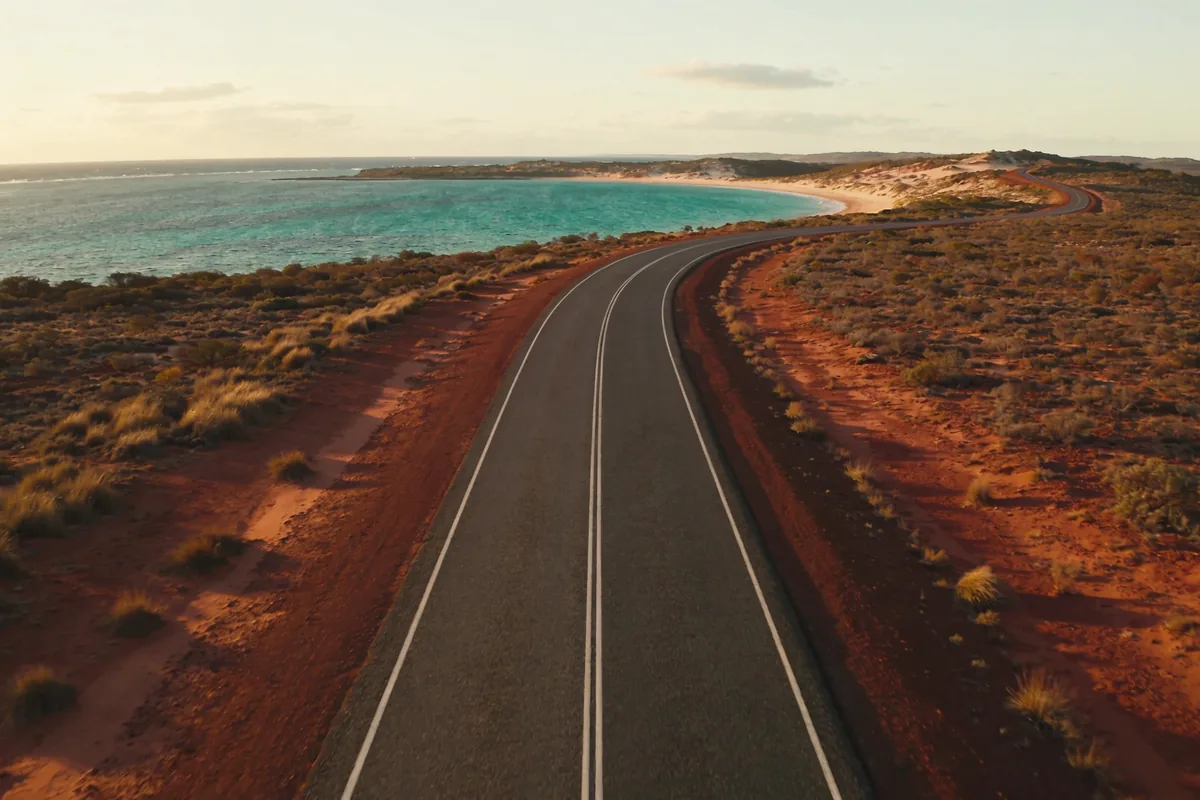
The sun is still low over the Indian Ocean when the first cars slip out of Perth, and by the time the city has fallen out of the mirrors the road has begun to change. Suburbs give way to scrub, scrub to a pale sand plain, and the horizon opens out until there is almost nothing between the bitumen and the water but sky.
Most people meet an Australian reef from the deck of a boat. That is how the famous one on the east coast works, and the assumption travels with you for years, until you read about the western coast and a sentence lands that you cannot unhear: there is a reef up there you can walk into. Not from a jetty and not after a tender ride, but from the sand, with the water barely up to your shins.
The drive that takes you there runs roughly 1,250 kilometres up the Coral Coast Highway from Perth to Exmouth, and it deserves more than a weekend. Give it ten days to a fortnight, aim for the dry season between about April and October, and let the journey be the point rather than the distance you have to cross. That is what separates this trip from a checklist. The reveal at the end is real, and it lands harder because of everything the road shows you first.
Out of the city, into the Pinnacles
The first leg north is gentler than the trip deserves. The highway carries you out of the suburbs and the coast runs alongside, and for a while the driving is easy enough to convince you the whole journey will feel like this. It will not. This is the stretch where the road teaches its first honest lesson about Western Australia: the distances between places are real, and the four hours from Perth to Geraldton are longer than the map suggests.
Most advice about this leg comes down to a single line, and it is worth repeating because it saves the trip from its weakest hour. Drive through the early beach towns. Cervantes and Jurien Bay have their uses, but the running local wisdom is that these are places to pass, because the country ahead keeps getting better. What they sit near, though, is the first strange landscape you will meet.
A short turn off the highway, Nambung National Park holds the Pinnacles, thousands of limestone pillars standing in a yellow sand plain like the ruins of a city that was never built. At sunset the low light rakes across them and the pillars throw long shadows, and it is the sort of place that makes you pull over without meaning to. You will arrive to find the car park half full and people standing very still, which is as close as this coast comes to a cathedral.
Treat the morning as a warm-up, because the road is sealed and the fuel is easy on this stretch. The warning worth taking seriously is the wildlife hours. Kangaroos and emus move at dawn and dusk, and a roo on the road does more damage than any late arrival, so if you are going to drive the long legs, drive them in the middle of the day.
If you are flying in from the east, the vehicle is a decision you make in Perth before the trip properly starts, and airport hire is where the biggest single cost of the drive gets set. A few minutes with our holiday travel hack on airport car rentals before you book tends to pay for itself in the first couple of days.
And if you want a local secret, the little fishing town of Leeman keeps a reputation for fish and chips that has travelled further than the town itself.
Geraldton and Kalbarri: where the coast turns serious
Geraldton arrives four hours in, and it is the last real city on the route, a working port town with supermarkets, fuel and everything a trip needs before the country opens up. It earns a proper stop rather than a drive-through, partly for the supplies and partly for its museum, which gives the town its due in the early story of space exploration.
Beyond Geraldton the coast finally begins to show off. Kalbarri is where the people who know this road say to spend the extra nights, and the reason is visible from the first lookout. The Murchison River has cut a set of gorges through the red sandstone, and where the river meets the sea the cliffs drop away in long, dramatic sweeps. Stand above a bend in the gorge in the late afternoon and the walls glow a deep rust red while the water runs green below, and you can lose an hour without noticing. If you have more than a night, give one day to the river and one to the coast below town, because they are two very different faces of the same park.
The wildflower country deserves its own mention. In late winter and spring, the inland between Geraldton and Kalbarri turns to colour in a way that stops even people who have seen it before. It is a seasonal gift, not a guarantee, which is exactly why it is worth building the timing in rather than leaving it to luck.
Kalbarri’s accommodation is limited, and it books out in the cool months and school holidays. The extra nights you will want are the ones to lock in before you leave home, not to gamble on finding when you arrive.
The Shark Bay decision
At a roadhouse where the highway splits, a turnoff heads west toward the Shark Bay peninsula, and this is the first genuine decision of the trip. The peninsula is a World Heritage coastline with a list of claims that sounds like a nature documentary: seagrass meadows that feed dugongs, a bay where wild dolphins swim in to meet people at the water’s edge, and at Hamelin Pool the living stromatolites, mound-building microbial communities counted among the oldest evidence of life on Earth.
The honest part is the geometry. The detour sits a long way off the highway, and the days disappear quickly once you commit to it. This is the first thing most travellers cut when leave runs short, and people who have driven the coast in both directions tend to give the same counsel: take it if you have the time, and skip it without guilt if you do not. Neither choice is wrong, which is what makes it a decision rather than a mistake.
If you do take it, give the stromatolites more than a glance. They are older than almost anything else you will see on the whole drive, and they do their ancient, slow work in water saltier than the open ocean, looking at first like ordinary rock. Knowing what they are changes how you see them, and that quiet shift is the whole trip in miniature.
Carnarvon: one night, then the road empties
Back on the highway the land dries out, and the next stop is Carnarvon, the plantation town strung along the Gascoyne River. After the red miles it comes as a small green shock: irrigated rows of bananas and tropical fruit in a landscape that looks too dry to hold them. The town’s tracking station once kept watch on the early space missions, and locals still tell that story with pride. The museum tells it well.
Carnarvon is a one-nighter. It is a good place to sleep, restock and point the car north again, but it is not where the trip lingers. If you have an afternoon to spare, drive a little south to Quobba, where the Indian Ocean surges up through fissures in the limestone and blows into the air, a raw and noisy spectacle that needs no commentary.
The practical warning matters more here than anywhere so far. After Carnarvon the road empties, and the places to buy fuel and food thin out quickly. Fill the tank, grab the supplies, and treat the distance ahead with more respect than the map suggests.
Coral Bay: the reef arrives
Just when the red country has started to feel endless, you reach the water again at Coral Bay, and the promise you set out with in Perth begins to pay off. Coral Bay is small and slow, a village arranged around a bay rather than built to impress you. That is its charm. The reef lagoon at Bill’s Bay sits a short wade from the sand, and you walk in off the beach, put your head under the water and find the coral growing in water shallow enough to stand in, with fish moving through it around your knees.
The choice of base comes down to temperament. Coral Bay is the quiet version, best for people who want the reef and very little else. Exmouth, an hour and a half up the road, has far more to do, with restaurants, tours and the full spread of the national park on its doorstep. Base yourself at Exmouth and you can day-trip back down to Coral Bay and out to the park, which is the way to have both without choosing.
Exmouth and the reveal
Exmouth is the practical heart of the top end, a genuine town with supermarkets, places to eat and operators running trips, and the gateway to Cape Range National Park, the sliver of limestone range that runs down the peninsula with Ningaloo on its western side. This is where the whole drive finally pays out.
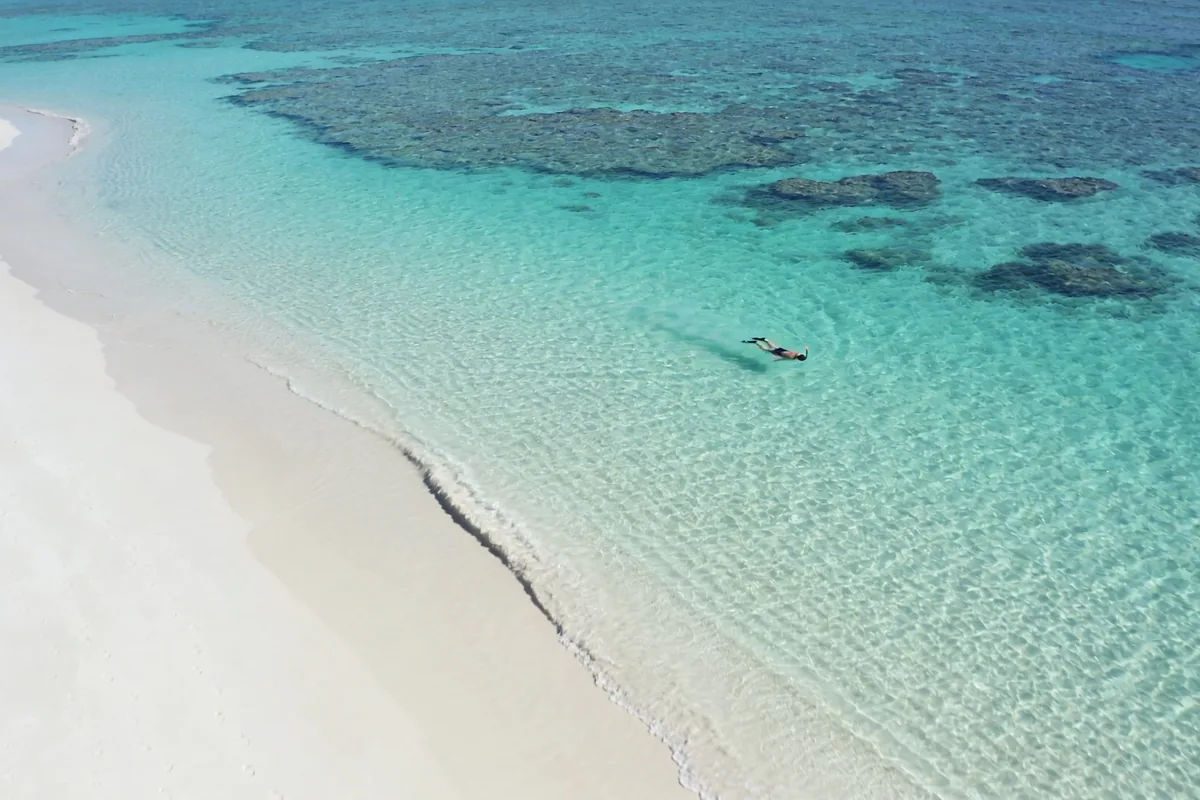
Inside the park the reef is not something you take a boat to. It runs along the shore, and at Turquoise Bay you reach the version the whole trip has been pointing toward. The sand is white, the water is a pale, brilliant turquoise, and the reef begins a few steps from the beach. You wade in, put your mask on, and the coral is right there beneath you, while the current does the work and carries you gently along the reef edge in the drift the bay is known for. Every guide uses the same phrase because it is true: no boat required.
Further along the park road, Yardie Creek cuts a tidal gorge through the range, and the water inside it is a different colour again, deep and green and still. A walk along the rim gives you the shape of the place, and a small boat trip takes you up the gorge itself. It is a quieter payoff than Turquoise Bay, and worth the drive for travellers who want the range as well as the reef.
The reef itself deserves a wider view, because from the beach its scale is easy to under-read. Ningaloo is one of the longest fringing reefs in the world, running for hundreds of kilometres up this coast, and the whole of it is protected as a marine park and a World Heritage area. Seen from the sand it is a band of darker water, but beneath the surface it holds turtles, reef fish, manta rays and, in the right months, whale sharks. That is a great deal of life within wading distance of where you park.
Two habits keep that water clear, and they are worth learning before you get in. Do not stand on the coral, even where it looks shallow, because it is alive and slow to mend. Wear reef-safe sunscreen or, better, a long-sleeved rash shirt, because the ordinary lotion washes off and does the reef no favours. The swimmers you will meet at Turquoise Bay float over the top and touch nothing.
The timing notes matter, because the top end runs on seasons. The whale-shark season runs roughly from March to August, peaking between April and July, and those tours are the exception that proves the rule: the whale sharks need a boat, and the coral does not. The best snorkelling is early in the morning, before the breeze builds and the water ruffles. The summer months, December to February, are punishingly hot and the gulf water turns bath-warm, so the cool dry season is the window to aim for. For the wider picture of how festivals and events shift demand around the year, our guide to festivals, events and the best time to travel fills in the rest of the calendar.
Two practical beats for the top end. Book Coral Bay and Exmouth accommodation well ahead for school holidays and the popular cool months, because the beds go first even when the roads are quiet. And after a long day in the water, leave the four-wheel drive parked for the evening; the town is walkable, and when dinner runs late it is easier to take a cab after dark than to drive back on unfamiliar roads.
The way home
The trip ends the way it began, on the same highway in reverse, unless you plan it otherwise. A one-way rental lets you fly home from Learmonth, the airport that serves Exmouth, and skip the drive back entirely. If you do drive, the coast looks different heading south, and the stops you rushed on the way up get a second chance, which is no hardship on a road this good.
Here is the whole drive in a few lines. Roughly 1,250 kilometres of Coral Coast Highway, ten days to a fortnight, timed for the dry season. Stop hard at Kalbarri, treat Shark Bay as a genuine choice, give Carnarvon one night and no more, and save your energy for the water at Coral Bay and Turquoise Bay, where the reef begins a few steps from the sand.
If the drive has put the idea of a long Australian road trip in your head, the other classic is the east coast run from Sydney to Cairns in a campervan, which has its own two-week guide if you want to weigh the two against each other. That coast sends you out on a boat to meet its reef. This one lets you wade.
So if someone asks whether the drive to Exmouth is worth it, the honest answer is that the reef at the end is only half of it. The road gives you the Pinnacles at sunset, the gorges at Kalbarri and long empty stretches where the red country runs to the sea, then finally water so clear you can stand in it and watch the fish work the coral. No boat required, and nothing between you and the reef but a few steps of sand. That is a journey worth a thousand kilometres.
Sources: Australia’s Coral Coast – The Coral Coast Highway · Tourism Western Australia – Ningaloo Marine Park · RAC WA – Perth to Exmouth road trip