Pets & Animals
Why Cats Bring You Dead Things (and Why It’s a Compliment)

The short version
- It is instinct, not hunger. A well-fed cat still hunts because the urge is separate from appetite.
- It is a family gesture. Mother cats bring prey to kittens to teach them, and your cat treats you as family, so you get the lesson too.
- Do not punish it. That only damages trust. The real lever for less hunting is keeping your cat indoors, especially at dawn and dusk.
There is a moment every cat owner knows. You shuffle to the kitchen in the morning, and there on the mat, presented with what looks like pride, is something that used to be alive. It is alarming, slightly gross, and strangely touching all at once. Understanding why your cat does it turns that confusing morning surprise into a small window into how your cat thinks.
The hunting instinct is not hunger
The first thing to know is that your cat is not bringing you dinner because it thinks you are starving. Cats are built to hunt, and the urge is separate from the need to eat.
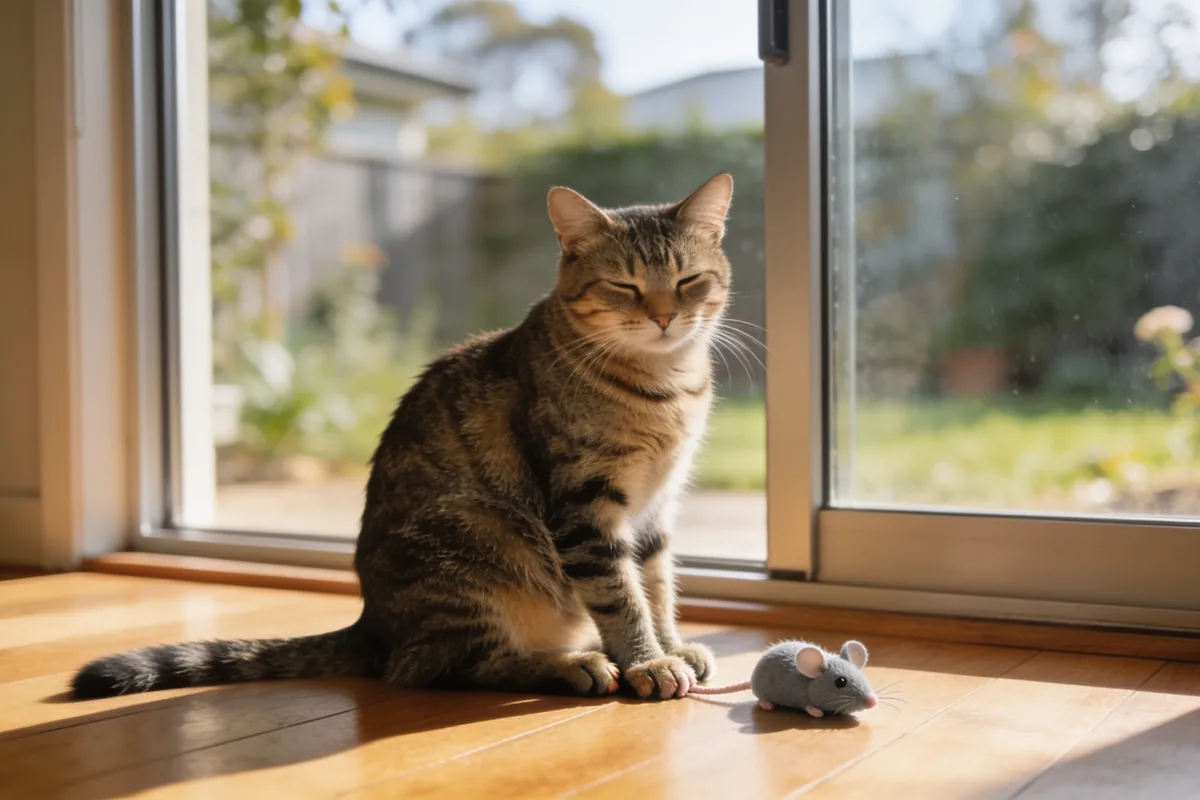
A cat with a bowl full of kibble will still stalk, pounce and catch, because that is what a cat’s brain is wired to do. The hunting instinct is its own drive, switched on by movement and sound, not by an empty stomach. This is why an indoor cat will happily chase a toy mouse across the kitchen floor and then walk past its dinner. The stalking is the point, and the catching is the reward, whether or not the cat is hungry.
Watch a cat play and you can see the sequence written into its body: the crouch, the slow stalk, the wiggle of the haunches and the pounce. Indoor cats run the whole routine on a toy, and the only step missing is the one at the very end. The instinct is the point, not the food.
Why they bring it to you
The delivering part is where it gets interesting. Mother cats bring prey home to their kittens to teach them how to catch and eat it. It is a lesson, delivered in the most practical way a cat knows: here is something that was moving, here is how you deal with it.
A cat that sees you as its family can point that same behaviour at you. That is why the gift lands at your feet, on your bed or by the door. In your cat’s mind, you are family, and you clearly need the lesson, because you are hopeless at catching things yourself. For an indoor cat, a toy mouse or a sock can stand in for real prey in the same behaviour. The cat is not confused. It is practising the family ritual with the tools it has.
Why it is a compliment
Here is the warm reframe worth holding onto. In cat terms, you are family, and the cat is either sharing the catch with you or trying to teach you to hunt. Veterinarians and behaviourists generally understand this as trust and social behaviour, not a problem to be trained away. Your cat brings you things because you matter to it.
That does not mean you have to enjoy stepping on a half-presented surprise at six in the morning. It is completely fair to find it unpleasant, and you can hold both truths at once: this is a sign of affection, and it is still not how you wanted to start the day. The gift says more about your cat’s feelings than about its table manners.
Your cat does not understand why you react the way you do. It has no idea that a dead mouse is not a welcome present, because in cat terms it is the best present there is. All it knows is that it brought you something valuable and you made a strange noise. That is worth remembering before you shout at it.
What to do (and what not to do)
The what-not-to-do list is short and firm. Do not punish the cat, shout at it, or rub its nose in the offering. Punishment does not stop a cat from hunting, because the instinct is not a behaviour the cat chooses. What it does do is damage trust, and a cat that learns you are dangerous when it brings you things will just learn to hide the gifts, or to hide from you.
What helps is calmer. A quiet “good cat”, then dispose of the prey without drama. And give the hunting instinct a better outlet: play that ends in a catch, where the cat gets to pounce on a toy and carry it off in triumph. The same redirection idea works across species, which is why the site’s look at toys that ease dog separation anxiety is built on giving an instinct a healthy job to do rather than trying to switch it off.
The honest note: if your cat goes outside, no amount of play will fully replace the real thing. The only reliable way to reduce the number of genuine gifts is to keep the cat indoors, especially at dawn and dusk, when prey is most active. That choice protects the local wildlife as well as the cat.
When it matters for health
Most of the time, a gift on the mat is just normal cat behaviour. But there is a health angle worth knowing. If your cat eats what it catches, it can pick up worms and parasites from the prey, which is why regular vet care and parasite prevention matter for a cat that hunts. A cat that never goes outside has a much lower risk, but it is still worth keeping up with the basics. A cat that hunts is doing what nature built it to do, and a routine vet visit keeps that natural behaviour from causing problems you cannot see.
If you are suddenly receiving gifts far more often than usual, or the cat seems unwell, it is worth a conversation with your vet. For most cats, though, this is normal, and it is not a sign that something is wrong. The site’s room-by-room guide to pet first aid at home is a good thing to have on hand for the moments that are genuinely emergencies, rather than the everyday offering on the doormat.
What the gift really means
The dead mouse on the doormat is your cat treating you as family and doing what cats have done for thousands of years. It is not a problem, and it is not a sign that your cat is broken or that you are doing something wrong. It is a compliment, delivered in the only currency a cat has.
Take the compliment, throw the mouse away, and give the hunter a better game to play. Your cat will love you for it, and you will both get through the morning with your dignity mostly intact.
Sources: RSPCA Australia, understanding cat behaviour and keeping cats safe · Australian Veterinary Association (AVA), cat hunting behaviour and parasite prevention · International Cat Care, why cats bring you prey