Travel
Two Weeks Is Enough for an East Coast Australia Road Trip (Do It in a Campervan)


The short version
- Run the coast one way. Sydney to Cairns, or the reverse if you would rather fly north and drive home. You cover roughly 2,400 km and never double back.
- Sleep in the van. A campervan is your bed and your kitchen, so you stop where the day ends and skip the hotel routine altogether.
- Decide campervan or car before you book anything. That one choice shapes the budget, the packing and the pace.
- Budget in ranges, not quotes. What you plan for and what you actually pay are rarely the same number.
- Go between April and October, and book school-holiday campsites and the three big tours ahead.
Two weeks is the version of the east coast most people actually get, and it is enough once you stop trying to see all of it. This is a working Sydney to Cairns plan for fourteen nights at an honest pace, trade-offs included.
The honest answer to “is two weeks enough?”
Ask the internet and the answer is usually no. The standard advice for an east coast Australia road trip is three to four weeks, sometimes more, and a quick search now hands back that line from an AI summary. For the trip where you do everything, that advice is fair. For the trip where you have a fortnight of leave and a real budget, it is not useful.
Here is the honest version. Two weeks is enough for a well-chosen run down the coast, and not enough for every beach, capital and side trip between Sydney and Cairns. Those are two different trips.
The fix has two parts: run the coast one way, and let the vehicle carry the sleep. Going north one day at a time, with no backtracking, turns fourteen days into fourteen useful ones. Add a campervan and the place you sleep travels with you. You wake up, drive for a few hours and stop where the afternoon looks good.
Australians put it more bluntly. The country is big, travel times run longer than the map suggests, and the best of the coast sits between the capitals. So cut a city and skip another. Do not try to land Sydney, Brisbane and Cairns in one fortnight and still see the coast, because the driving eats the trip.
That is the real trade-off of two weeks. You will leave things out, and the trip is better for deciding what they are before you leave, rather than discovering it when the leave runs out.
The two-week route, stop by stop
The classic two-week run is Sydney to Cairns. Here is a night-by-night shape that fits, with the honest long drives kept in.
- Blue Mountains, one night. Pick up the van, get out of the city and sleep among the trees. A short walk the next morning sets the pace.
- Port Stephens, one night. Dunes and a dolphin cruise make an easy first stop, and the drive north leaves the afternoon free.
- Coffs Harbour, one night. The practical halfway stop that breaks the long middle stretch. The beach is fine.
- Byron Bay or Brunswick Heads, two nights. Byron is the famous one and it knows it. Brunswick Heads, twenty minutes north, is quieter, and locals keep recommending it. Choose by whether you want the scene or the sleep.
- Brisbane, one night. A restock point rather than a destination. Good food and big supermarkets, and the theme parks wait for another trip.
- Noosa, two nights. Beach days and the headland walk in the national park. This is where the run starts to feel like a holiday instead of a drive.
- Rainbow Beach, one night. Gateway to K’gari, and the easy place to take a day tour onto the sand island without a 4WD.
- Agnes Water or Rockhampton, one night. The honest long-leg stop, because Rainbow Beach to Airlie Beach is too far for one comfortable day.
- Airlie Beach, two nights. The Whitsundays boat day is the one tour worth booking ahead. Whitehaven Beach and Hill Inlet are the payoff.
- Mission Beach, one night. Rainforest, reef and cassowary country, and the best chance on the route of seeing one.
- Cairns, two nights. A reef day trip or a drive to the Daintree and Cape Tribulation. Want both? Steal a night from the southern coast, because each deserves a full day.
That is fourteen nights, and the shape is deliberately loose. The map lies about time: two real stops a day is a full day, four is a blur, and fuel, photos and wrong turns eat the hours. If the reef is your reason, give Cairns an extra night and take it from the New South Wales coast. If surf is the draw, linger around Byron and Noosa and treat the far north as a quick finish.
Running the route south instead, from Cairns to Sydney, works the same way and ends in a bigger city, which suits travellers flying home from Sydney or Melbourne. Reverse the stop order, keep the same one-way logic, and the plan still fits a fortnight.
Campervan or car: the decision that shapes the trip
Make this call before you book anything, because nothing else changes the trip as much.
A campervan replaces your accommodation. You pay more per day than for a hire car, and in return you skip the nightly room bill, can stop where there is no town, and carry a kitchen that keeps food costs down. For two people sharing, a standard two-berth van from the main operators runs in the low-to-mid hundreds of dollars a day, less booked early and outside school holidays, more with four-wheel drive. That rate does double duty as your bed, so it usually beats the same nights in hotels.
A hire car with cabins and motels is the other way in. It costs less per day and parks easily in town, but every night adds a check-in, a key and a bed that costs real money, and you eat out more with no kitchen in the boot. It suits travellers who would rather sleep in a proper room and do not mind finding one each afternoon.
The one-way drop-off fee is the hidden cost in both options. Most companies charge extra for a Sydney pickup and a Cairns return, and it is still usually the better deal once you count the days you save by not driving back. A mix works too: take the van for the coast leg and let a train or a flight bring you home.
Size matters. A big four-berth camper is harder to park, thirstier on fuel and more stressful on narrow roads. And a van does not make everywhere reachable: K’gari’s sand tracks and the rougher roads near Cape Tribulation need four-wheel drive. A normal campervan does not go on Fraser Island, so plan a day tour for those legs.
What it really costs
Nobody can give an honest fixed quote, because prices swing with season, fuel and how you like to sleep. Treat every figure as a range and add a buffer on top.
Van hire is the biggest line. Budget in the low-to-mid hundreds of dollars a day for a standard two-berth from the main operators, less booked early and outside school holidays. Across two people it still usually beats hotels, because one payment covers transport and a bed. Peak season and one-way drop-offs push it up.
Campsites are where the van earns its keep. Paid parks and campgrounds cost a fraction of a room, typically tens of dollars a night for a powered site. The catch is timing: coastal parks fill in school holidays, so book the ones around Byron and Airlie ahead.
Fuel for the roughly 2,400 km run, plus detours, is a serious number, so treat it as a fixed daily cost. Prices differ between states and climb the further north you go.
Food is the lever you control. A two-burner cooktop and an esky turn a cafe breakfast into a kitchen one, and that difference over fourteen days is the biggest saving on the trip. Eat out for the experience, cook the rest.
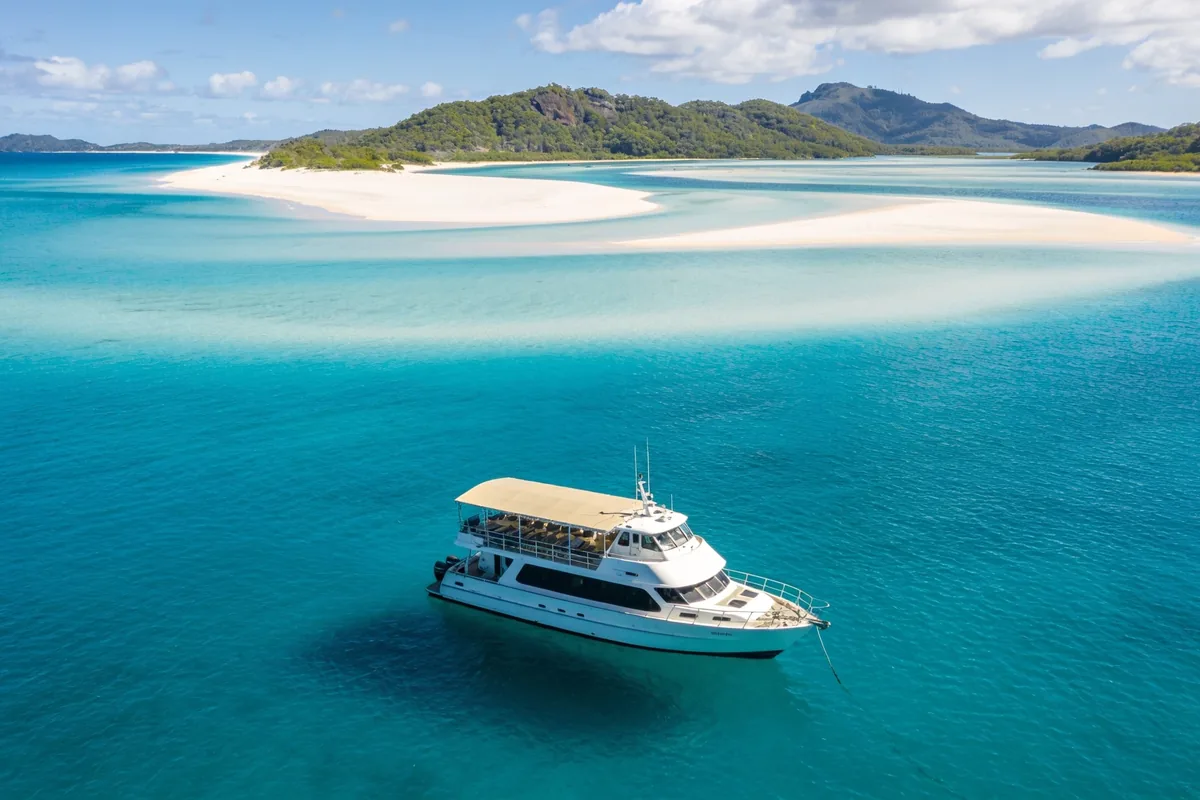
The three big tour spends are the Whitsundays boat day, a reef trip from Cairns and a K’gari day tour, each in the hundreds of dollars per person. Budget for them properly, and book the good ones ahead because the calm-weather windows go first. A plan that starts at around $500 a week tends to run to $700 or $850 once tours, campsites and restaurants are counted.
The freedom-camping reality check
The myth is that you can free-camp your way down the coast and only pay for fuel. Reliable free camping mostly sits inland, and the good coastal spots fill first. Treat it as a tool, not the whole strategy.
The apps that work are WikiCamps and Camps Australia Wide. They list free spots, cheap parks and everything between, and the offline maps help when the signal drops. Between them you will use showgrounds, national park campgrounds and ordinary caravan parks, and most towns on the route are used to campervanners passing through.
Two notes. In the humid months up north, pay for a powered site with air-conditioning so one sticky night does not wreck the next day. And around Byron, and in school holidays, book ahead, or you will be the one parked awkwardly at a rest stop watching everyone else settle in.
None of this means skip the van. It means plan a mix of free and paid nights, with the paid ones locked in where the crowds are.
When to go
The window that suits the whole coast is April to October. The south is dry and mild, Queensland is warm but not punishing, and the rainforest roads stay open. May and June are the sweet spot, because September and October bring school-holiday crowds and the prices that travel with them.
The broader guide to festivals, events and the best time to travel explains how timing shifts by region, which helps if you want to catch a market or dodge a crowd on purpose.
Summer needs care. School holidays bring heat, crowds and premium prices, and in the far north the monsoon can close the rainforest roads. The coast is still beautiful in January, just not the relaxed version of itself.
If the northern end is the point, the timing logic flips. The Top End is best in the dry season, roughly May to September, which is a different journey from the coastal run. Read the guide to the best time to visit Darwin before tacking the north onto the plan.
Practical advice that saves the trip
Drive the long legs in the middle of the day. Out of the cities, kangaroos and wallabies are most active at dawn and dusk, and hitting one does more damage than arriving late. The route is mostly two sealed highways, the Pacific Motorway to Brisbane and the Bruce Highway north, which keeps the driving easy and makes wildlife the main risk.
Sort connectivity before you land. Navigation eats data and roaming charges are miserable. An eSIM set up before you fly works the whole way up the coast for a fraction of the cost.
Book the weather-dependent trips from the road, not from home. Reef days and the Whitsundays boat run on calm conditions, and operators will not sail when the wind is up. Booking a day or two out lets you pick the good window.
In the bigger towns, leave the van parked. Manoeuvring a campervan into central Byron, Brisbane or Cairns at night is a hassle, and a couple of drinks settle the argument. Take a cab after dark and collect the van in the morning.
If Byron or Airlie feel like a queue, quieter spots are close. Brunswick Heads, Yamba and Mission Beach keep coming up when locals talk about where they would go, and all three sit on this route.
Check the van before you leave the lot. Confirm whether bedding and cookware are included and whether the kilometres are capped, because on a 2,400 km run an unlimited-kilometre deal changes the maths. Ask, rather than assume.
Restock the pantry and the fuel tank in the bigger towns, where supermarkets and servos compete on price. Up the coast the choices narrow and the prices climb, so a proper shop in Brisbane or Cairns saves money later.
The short version again
Two weeks is enough for the east coast when you run it one way, let a campervan carry the sleep and accept that you are choosing rather than missing out. Book the three big tours and the school-holiday campsites ahead, keep the rest loose and treat every price as a range.
The mistake is trying to fit a three-week trip into a fortnight. Plan a two-week trip instead, and come home rested rather than exhausted.
The coast rewards the traveller who moves at its pace. Fourteen days, one direction and a van that sleeps two is a proper trip, not a compromise. Go.
Sources: Tourism Australia – Sydney to Cairns itinerary (australia.com) · Campervan Village – 14-day Sydney to Cairns itinerary (campervanvillage.com)