General
Sun-Powered Pros and Cons: Is Solar Really Worth It for You? 🌞⚖️

So, you’ve been thinking about solar energy.
Your neighbour just installed panels and won’t stop talking about his $0 electricity bill.
But you’re still unsure. Is it worth the upfront cost? Will you end up roasting in summer without savings?
Time to settle it — let’s put Team Solar ☀️ against Team Grid ⚡ in a good ol’ Aussie-style face-off.
🥊 Round 1: Cost 💰
⚡ Team Grid
- Average Aussie household pays $1,600/year on electricity.
- Rates keep climbing — up 20% in some areas since 2022.
- You’re at the mercy of energy companies.
☀️ Team Solar
- Install cost in Melbourne or Perth: $4,000–$10,000 for a typical 6.6kW system.
- With no battery, your bill can drop to $400/year or less.
- Add a battery and it’s $900/year average — still cheaper in the long run.
✅ Winner: Team Solar
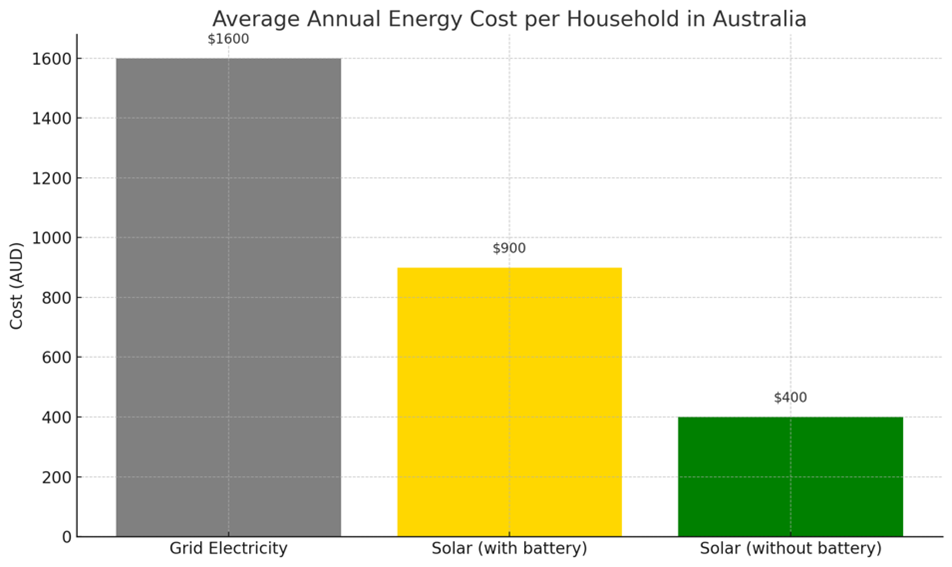

(See chart above)
🔋 Round 2: Energy Independence 🏡
⚡ Team Grid
- You’re reliant on the network.
- Power outages? You’re sitting in the dark unless you’ve got candles and baked beans.
☀️ Team Solar
- With panels and a battery, you’re mostly self-sufficient.
- In WA, feed-in tariffs let you earn a little back.
- In VIC, solar rebates and loans make going solar easier.
✅ Winner: Team Solar
🌍 Round 3: Environmental Impact 🌱
⚡ Team Grid
- Largely powered by coal and gas, especially in Victoria.
- Higher carbon emissions and pollution.
- Not exactly winning any green awards.
☀️ Team Solar
- Panels generate clean, renewable energy.
- A 6.6kW system offsets 6–10 tonnes of CO₂ per year.
- Reduces Australia’s reliance on fossil fuels.
✅ Winner: Team Solar
(And so is the planet.)
🛠️ Round 4: Maintenance 🔧
⚡ Team Grid
- No maintenance needed — you just pay your bill and flick the switch.
- That’s the only upside.
☀️ Team Solar
- Minimal maintenance: just clean panels every 6–12 months.
- Inverters and batteries may need replacement after 10–15 years.
- Inverter cost: ~$1,000–$2,000
- Battery cost: ~$7,000–$12,000
❌ Winner: Team Grid (barely)
Solar’s upkeep is low — but not zero.
🌦️ Round 5: Weather and Reliability 🌧️
⚡ Team Grid
- Reliable 24/7, rain or shine.
- Great during Melbourne’s four-seasons-in-a-day routine.
☀️ Team Solar
- Still works on cloudy days — just at lower efficiency.
- Night-time? You’ll need battery storage or switch back to grid power.
- Perth gets more sun, so better ROI up west.
🤝 Draw — Depends on your location and setup.
📈 Round 6: Return on Investment (ROI) 📊
⚡ Team Grid
- ROI = none.
- You’re paying forever — like renting with no option to buy.
☀️ Team Solar
- Payback period: 3–7 years, depending on system and usage.
- After that, you’re saving hundreds to thousands annually.
- Adds resale value to your home — especially in Melbourne and Perth where green homes sell faster.
✅ Winner: Team Solar
🏗️ Bonus Round: Rebates and Incentives 🎁
VIC Solar Incentives
- Up to $1,400 off solar panels
- Interest-free loans available
- Solar battery rebate up to $2,950
(Source: Solar Victoria)
WA Solar Support
- No upfront rebates
- But higher sunlight hours = faster ROI
- Access to feed-in tariffs and community energy schemes
💡 Most states also offer Small-scale Technology Certificates (STCs) — tradable credits that reduce upfront solar costs.
🤷♂️ So, Who Should Stick with Team Grid?
- Renters, unless your landlord is super eco-friendly.
- Households with heavy night-time usage but no battery.
- Homes heavily shaded or with unsuitable roofs.
If that’s you, consider green energy providers instead. It’s still better than sticking with coal-based energy.
💬 Common Myths Busted
“Solar only works in summer.”
❌ Nope — works year-round, just more efficiently in sunny months.
“Panels need heaps of maintenance.”
❌ False — rain does half the cleaning for you. Just a yearly check-up is enough.
“Too expensive.”
❌ Not anymore. Prices dropped over 80% in the last decade.
With rebates, payback is faster than ever.
🌟 Final Verdict: Who Wins the Match?
| Category | Winner |
| Cost Over Time | ✅ Solar |
| Environmental Impact | ✅ Solar |
| Maintenance Ease | ✅ Grid |
| Reliability | 🤝 Tie |
| Long-Term ROI | ✅ Solar |
🏆 Overall Winner: Team Solar
If you own your home, live in a sunny spot (hello, Perth), or want to slash bills long-term — Solar’s the clear choice.
🌞 Your 5-Step Solar Decision Checklist
- ✅ Check your roof: size, shade, and orientation
- ✅ Look up rebates for your state
- ✅ Get 2–3 quotes from accredited installers
- ✅ Ask about warranties (aim for 10–25 years)
- ✅ Work out your break-even year using your usage and feed-in tariff
Still unsure? Start with a small system and grow it later.
🥂 Final Word: Shine Bright Without Burning Your Wallet
Solar energy in Australia isn’t just a good idea — it’s almost a no-brainer.
Especially with sunlight on tap, rebates in your corner, and energy bills climbing like a huntsman on the bathroom wall — going solar could save your bank account and the planet.
So whether you’re a beachside Perth local or a brunch-loving Melburnian, it’s time to back Team Solar — and let the sunshine do the heavy lifting.
Sources:
- Solar Victoria
- SolarQuotes Australia
- Clean Energy Regulator
- Energy Made Easy
- Choice Solar Calculator