


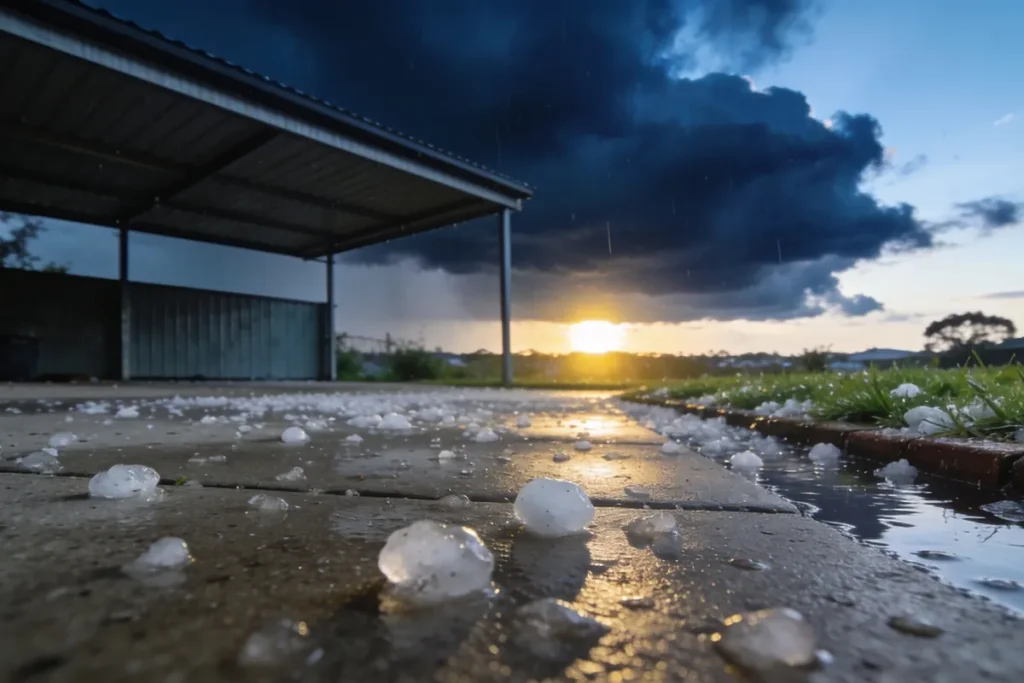
A hailstorm leaves a car owner with three decisions, and they arrive in a fixed order. The first is whether any policy responds to the damage. The second is whether the car will be repaired or written off. The third is whether the offer that follows should be accepted or disputed.
The position taken in this guide is that only a comprehensive policy pays for hail damage to the owner’s own car. A third party property policy does not, and a third party fire and theft policy does not cover storms. Once the claim is lodged, the assessor decides between repair and write-off on an economic test, not on a fixed percentage. An owner who understands that test, and the deductions that follow it, is in a stronger position to dispute a valuation that is wrong.
This is general information, not financial product advice. Policy wordings differ, and the product disclosure statement is the document that governs a particular claim.
1. Which policy pays
Comprehensive car insurance covers a vehicle damaged by fire or weather events. Hail is a weather event. That is the short answer, and it is the answer Moneysmart gives: comprehensive cover responds, and third party property cover does not cover damage to the insured car.
The distinction between the policy types is worth stating plainly, because storm seasons produce a great deal of confusion about it.
- Comprehensive: covers damage to the insured vehicle from weather events, including hail, subject to the policy terms, exclusions and excess.
- Third party property: covers damage the insured vehicle causes to other people’s property. It does not cover damage to the insured vehicle itself.
- Third party fire and theft: covers fire and theft, and the third party liability. It does not cover storm damage.
Hail is typically covered under comprehensive cover, but not under every comprehensive policy. The product disclosure statement may carry an exclusion, a condition about where the car is kept, or a different excess for weather damage. The owner should read the policy before the storm, not after it.
If the car is insured for third party property only, a hail claim has no responder. The damage is the owner’s to fund, and the cost of repair sits against the value of the car. If the car is insured comprehensively, the claim is with the owner’s insurer, and the policy terms decide the rest.
2. The first week, in order
The first week after a hailstorm is a sequence, not a scramble. The order matters because a repair authorised too early can complicate a claim, and photographs taken after a clean-up can lose the evidence that supports it.
- Check the car is safe to use. Hail can break glass and leave sharp edges. If the windscreen is cracked or a window is broken, the car should not be driven until it is safe.
- Photograph the damage before cleaning. RACV’s guidance is to photograph the car as soon as it is safe to do so, before any cleaning or repairs. Wide shots show the panels; close shots show the dents and the glass. The roof, bonnet, boot lid and every glass panel deserve a frame.
- Lodge the claim early. Insurers and consumer guidance both recommend contacting the insurer promptly. In a major storm, the assessment queue grows quickly. Lodging early is the part of the process the owner controls.
- Do not authorise repairs before the insurer agrees. RACV’s guidance is to contact the insurer before arranging repairs. A repairer who starts work before the assessment can create a dispute about who authorised the cost.
- Keep the car available for assessment. The insurer will nominate an assessment location or an assessment centre. The owner should ask where the car needs to be and when, and should keep the claim number, the photographs and every piece of correspondence.
There is one more step that costs nothing and saves trouble later: ask the insurer to confirm the basis of the assessment in writing. That request is reasonable at the start of a claim, and it gives the owner a document to check against the final offer.
3. What the assessor decides
The assessor’s decision is binary in form: repair or write off. The reasoning behind it is economic.
Western Australia’s Department of Transport states the test used for the written-off vehicle scheme: a vehicle is a total loss when the cost of repairs plus its salvage value is more than the vehicle’s market or insured value. Other states and territories run their own schemes, and the wording in a particular policy may differ, so check the scheme that applies where the car is registered. Repair cost alone is not the number. Repair cost plus what the wreck is worth is the number.
A product disclosure statement may express the same idea in different words. RACV, for example, describes a write-off as a situation where the cost to repair the damage exceeds the vehicle’s value. The phrase “uneconomical to repair” appears in some policy wordings for the same reason: the insurer is comparing the cost of repair with the value of the car.
One widely repeated figure needs correcting. A common claim holds that a car is written off when the repair quote reaches 50 to 75 per cent of its market value. That figure is a rule of thumb, not the test. It appears in repairer commentary, and it can produce the wrong answer in both directions. A quote below the band can still be a write-off once salvage is counted. A quote above the band can still be a repair if the salvage value is low and the insured value is high.
The test is the comparison, not the percentage. The percentage is a shortcut that sometimes points in the right direction and sometimes does not.
4. The maths, with a hypothetical car
Two hypothetical cases show why the percentage is not the test. Both cars have a market value of $14,000 and an excess of $800. The repair quotes and salvage values differ.
| Item | Case A | Case B |
|---|---|---|
| Market value | $14,000 | $14,000 |
| Repair quote | $9,600 (69% of value) | $12,500 (89% of value) |
| Salvage value | $2,000 | $2,000 |
| Repair plus salvage | $11,600 | $14,500 |
| Test against $14,000 | Below, so repairable | Above, so a write-off |
| Payout after $800 excess | Not applicable | $13,200, less remaining premiums |
Case A is the case the rule of thumb gets wrong. The repair quote is 69 per cent of the car’s value, inside the 50 to 75 per cent band that is often described as the write-off zone. But the test adds the salvage value: $9,600 plus $2,000 is $11,600, which is below the $14,000 market value. On the scheme test, the car is repairable.
Case B is the case the band gets right by accident. The repair quote is $12,500, or 89 per cent of value. Add the $2,000 salvage value and the total is $14,500, which is above the $14,000 market value. The car is a write-off.
The arithmetic changes with the values. A lower salvage value or a higher insured value can pull a large repair quote back under the line. A higher salvage value can push a smaller quote over it. That is why the percentage should be treated as a warning sign, not a decision rule.
The payout is a separate calculation from the write-off decision. Four deductions matter.
- Excess. The excess is deducted from the settlement. In Case B, $14,000 less an $800 excess is $13,200. It is a different figure from the excess on a hire car, which the site’s guide to car hire excess explains.
- Remaining premiums. If the policy is paid monthly, the insurer may deduct the premiums still owing for the rest of the period. In one reported case from the 2025 storm season, a monthly payer had $1,700 deducted from the payout.
- Finance. If the car is financed, the lender is paid first. The payout may settle the loan, or it may leave a shortfall if the amount owing is higher than the settlement. The structure of the finance matters as well; the site’s comparison of a chattel mortgage and a finance lease sets out the difference.
- Salvage. If the owner keeps the wreck, the salvage value is deducted from the payout. That is the same number the scheme test counts as part of the cost.
Agreed value and market value produce different starting numbers. A market value policy assesses the car at claim time, using trade guides such as RedBook, Glass’s or AutoGrab and recent sold prices. An agreed value policy fixes the number at purchase or renewal. The test uses the market or insured value, so the policy type changes the figure that the repair cost is measured against.
5. If the car is written off
A written-off vehicle is not one category. A repairable write-off may be repaired and returned to the road if it meets the requirements of the written-off vehicle scheme in the relevant state or territory. A statutory write-off may not be returned to the road, because the damage is judged too severe or the vehicle is judged unsafe.
The register matters in both cases. A write-off is recorded, and the record follows the car. That affects what an insurer will do with it later and what a buyer will pay for it.
If the insurer offers to let the owner keep the wreck, the financial effect is a deduction. The salvage value is taken out of the payout, because the owner is receiving the car as well as the cash. The car then carries a write-off record, which can make it harder to insure and harder to sell. The owner should establish those two consequences before agreeing to the deduction, rather than after.
A repaired car may never be the same. That is not a reason to refuse a repair, but it is a reason to inspect the work and to keep the assessment report. The fair point on the other side is that a write-off can be the correct economic answer. When the repair cost plus salvage genuinely exceeds the value, writing the car off is not a lowball tactic. It is the scheme working as designed.
6. If the owner disagrees
The first offer is not final. A dispute about it needs evidence, not indignation.
The evidence starts with the assessment. The owner should ask the insurer for the basis of the valuation and the repair quote in writing, including the market value figure, the comparables used, the salvage estimate and every deduction. A settlement figure without those numbers cannot be checked.
The strongest evidence on value is recent sold prices for comparable cars, not asking prices. An independent valuation from a qualified valuer is the other route. Trade guides are a starting point; a valuer can explain why a particular car sits above or below the guide.
The insurer’s internal dispute resolution process comes first. If that does not resolve the matter, the dispute can go to the Australian Financial Complaints Authority, which is free for consumers. The Authority’s number is 1800 931 678. The owner should keep the photographs, the assessment report and every letter and email.
A dispute can succeed on the valuation, on the repair scope, on the salvage figure or on a deduction. It can also fail, because the insurer’s number may be right. The purpose of the process is to test the number, not to assume it is wrong.
7. The queue in a bad season
Storm seasons produce volume, and volume produces delay. In the 2025 season, about 40,000 motor claims followed the hailstorms that hit Queensland and parts of New South Wales. Insurers reported 15,150 claims in the week from 26 October to 2 November and 24,000 in the week from 20 to 27 November. Suncorp reported about 6,500 claims and RACQ about 8,255. Suncorp said a high proportion of its claims were total losses.
The result is a queue. Assessment centres fill, assessors are stretched, and minor hail damage can take a week or longer to repair. Lodging early helps, but it does not move a car to the front of a queue that is already long. Repairs can wait; the claim should not.
The owner should also expect a difference between the headline payout and the amount that reaches the bank account. Deductions are normal, and they are easier to challenge when the owner has asked for the calculation in advance.
8. What to do before the assessor calls
- Make the car safe. Broken glass and sharp edges come before paperwork.
- Photograph the damage before cleaning or repairing anything.
- Lodge the claim early, and ask for the assessment basis in writing.
- Do not authorise repairs before the insurer agrees.
- Keep the car available, and keep every document.
The cover question is narrower than it first appears. Only comprehensive cover pays for hail damage to the owner’s own car. The assessor then decides between repair and write-off on the scheme test: repair cost plus salvage value against the market or insured value. The 50 to 75 per cent figure is a rule of thumb, not the test.
If the offer that follows is wrong, the owner can dispute it with comparable sales evidence, an independent valuation and, if necessary, the Australian Financial Complaints Authority. The first offer is a starting point. The evidence decides the rest.
Sources: Car insurance, Moneysmart (https://moneysmart.gov.au/car-insurance/choosing-car-insurance); Car hail damage: what to do, RACV (https://www.racv.com.au/royalauto/transport/cars/car-hail-storm-damage.html); Write-off a vehicle, Western Australia Department of Transport (https://www.transport.wa.gov.au/licensing/vehicle/written-off-vehicles/write-off); Car insurance: agreed value vs market value, Insurance Council of Australia (https://insurancecouncil.com.au/wp-content/uploads/2026/04/20260401_Car-Insurance-Valuation-FAQs.pdf); Tens of thousands of cars damaged after hailstorms lash Queensland and parts of New South Wales, ABC News (https://www.abc.net.au/news/2025-12-04/hail-damage-to-cars-what-to-do/106097274)