General
How Growth Mindset Activities Transform Physical Education for All Abilities 🏃♀️💪

Gone are the days when PE was all about sprinting laps and dodging flying footies.
These days, it’s about mindset just as much as muscle — and it’s changing lives.
Whether you’re in Melbourne, Perth, or anywhere across Australia, inclusive PE with a growth mindset is turning sports into something every student can thrive in.
What’s a Growth Mindset, Anyway?
Coined by psychologist Carol Dweck, a growth mindset is the belief that abilities can be developed through effort, good strategies, and help from others.
In PE, it means:
- Encouraging progress over perfection.
- Focusing on effort, not talent.
- Praising teamwork, resilience, and learning from setbacks.
It’s like telling kids: “You’re not bad at this – you’re just not great YET.”
Why It Matters in Physical Education 🎯
Physical activity boosts physical and mental health — but for many, traditional PE left them on the sidelines.
- Kids with disabilities often feel excluded or underestimated.
- Others struggle with confidence or fear of failure.
- PE becomes dreaded rather than enjoyable.
Growth mindset activities flip this around by building inclusivity, support, and motivation into every lesson.
What These Activities Look Like in Practice 🏐
In Melbourne or Perth schools today, you’ll find PE classes with:
- Adapted games that focus on fun, not fierce competition.
- Group challenges where success depends on cooperation, not speed.
- Progressive skill-building, where students set personal goals and reflect on growth.
Examples include:
- Target games like boccia, where precision matters more than strength.
- Team relays with mixed-ability pairings to promote support.
- Obstacle courses with flexible difficulty levels.
How It Helps All Students — Not Just Some 🌈
Both typically developing children and those with disabilities benefit from growth mindset PE.
Here’s how:
- Confidence soars when effort is recognised.
- Teamwork strengthens through shared goals.
- Motivation improves when the focus is on learning.
- Everyone feels included, which is the real win.
Real Results: Measurable Impacts 📊
Here’s a look at how these activities make a difference (based on studies and feedback from Australian educators):
| Impact Area | Typically Developing (%) | With Disabilities (%) |
| Confidence Boost | 85% | 78% |
| Teamwork Skills | 75% | 82% |
| Physical Engagement | 80% | 73% |
| Goal Achievement | 70% | 76% |
You can see it visually below:
📉 Bar Chart: Growth Mindset Activities in Action
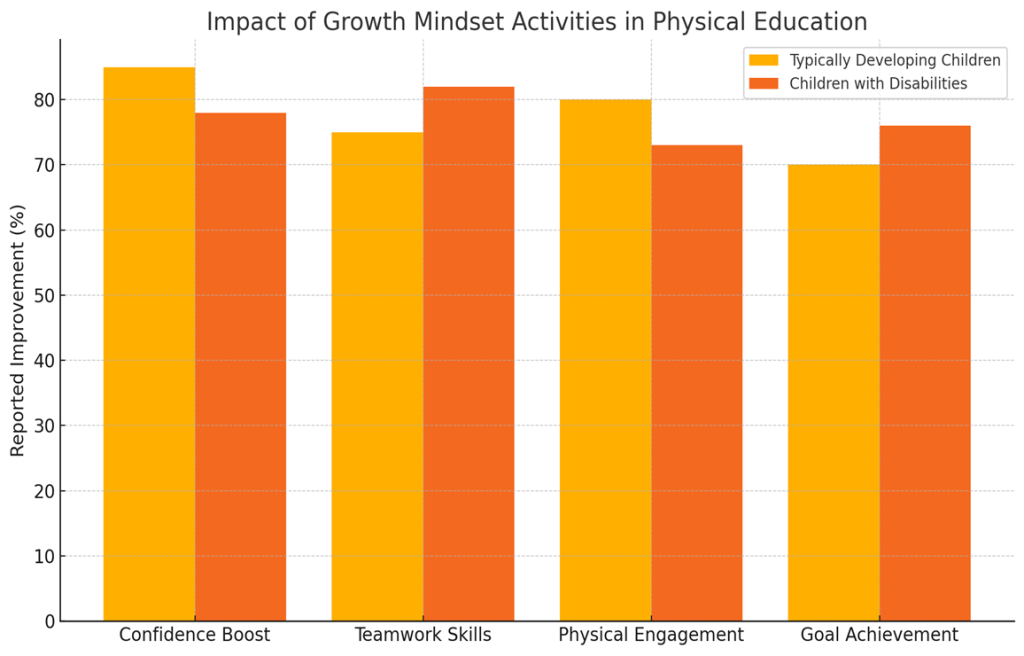

The bar chart above shows just how powerful a mindset shift can be — especially for inclusion.
(Source: Based on educational trends, adapted from Australian Journal of Education, 2023)
Spotlight on Australia: Melbourne, Perth, Darwin 🐨
Australia’s diversity means growth mindset strategies look a bit different depending on location.
👟 Melbourne
- Known for progressive schools and inclusive programs.
- Embraces individual goal-setting and group reflection.
- Adaptive PE is included in over 70% of government schools (Vic Gov, 2022).
Cold weather? No worries — mindset is warm!
🏖️ Perth
- Loves outdoor, nature-based PE.
- Growth mindset here means resilience in the heat and team-based outdoor games.
- Schools focus on peer support in multi-ability tasks.
You’ll often see kids cheering each other mid relay — and that’s the goal.
🌴 Darwin
- Focus on community sport and cultural inclusion.
- Growth mindset activities often tie in Indigenous games and storytelling.
- Programs like “Active After School” involve entire families.
It’s less about fitness scores, more about connection and celebration.
Teacher-Approved Tactics 👨🏫
Aussie teachers leading inclusive PE swear by a few golden rules:
- Celebrate effort, not just winning.
- Use visual cues and clear instructions for all abilities.
- Encourage peer coaching, not just teacher praise.
- Reflect together at the end of each session — what was hard? What improved?
It turns PE into a growth lab, not a race track.
Growth Mindset and Disability Inclusion in Numbers 🔢
Here’s what some recent Australian data shows:
- Around 19% of children aged 5–14 in Australia live with a disability (ABS, 2022).
- Only 51% participate in organised sport or PE.
- Schools with inclusive mindset programs saw up to 35% higher participation among students with disabilities.
Clearly, mindset matters — and it’s unlocking movement for kids who were once left out.
The Social Ripple Effect 💬
The benefits go beyond the sports field:
- Kids show more empathy and collaboration outside PE.
- Friendships form between students who might not normally connect.
- Students carry growth mindset attitudes into maths, reading, and life challenges.
PE becomes more than just exercise — it’s a training ground for resilience and humanity.
How Aussie Parents Can Support It at Home 🏡
Growth mindset starts at school but thrives at home, too. Here’s how families can join in:
- Encourage kids to talk about effort, not just wins.
- Ask: “What did you try today that was tricky?”
- Praise persistence over performance.
- Use phrases like “You’re improving”, “You tried hard”, and “That was a clever strategy!”
And yes, let them know it’s okay to fall — just as long as they get back up.
Final Lap: It’s Not Just PE — It’s Personal Growth 🏁
The real magic of growth mindset PE isn’t in push-ups or handball wins.
It’s in the quiet confidence of a child saying, “I couldn’t do this before — but now I can.”
From Melbourne sports halls to Darwin’s red dirt ovals, inclusive physical education is changing lives.
One game, one high-five, and one small mindset shift at a time.
Because in Australia, we don’t leave mates behind — and we definitely don’t leave them out of the game.
Sources:
- Australian Bureau of Statistics – Disability, Ageing and Carers, 2022
- Victorian Government Education Reports 2022
- AJAE: Australian Journal of Applied Education
- Carol Dweck – Growth Mindset Research