


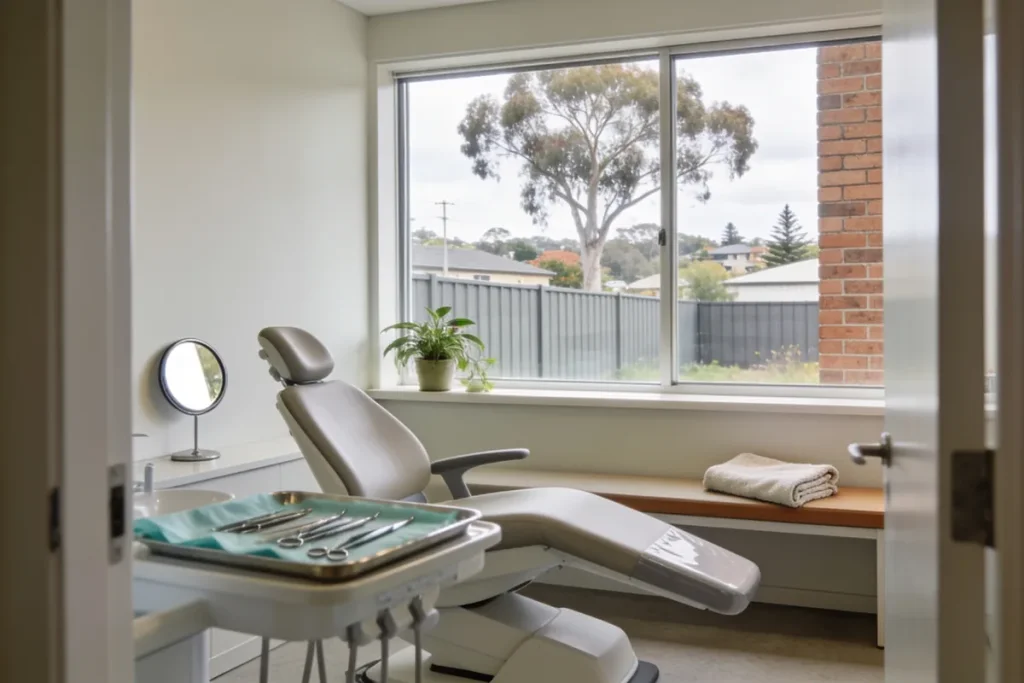
- A check-up is an examination first and a clean second. The clean is one part of the visit, not the whole of it.
- It covers more than your teeth: your gums, lips, tongue, mouth and saliva are all part of the appointment. Some of that is a look for things you would never feel yourself.
- How often you go is a clinical decision, not a fixed rule, and for most adults it lands somewhere between six and twelve months.
- The most useful thing you can say before the check-up starts is that you are nervous, if you are. It changes how the appointment is run.
- You are allowed to ask what is being measured, what your numbers were, and what happens next.
Most adults turn up to a check-up with a vague sense that they should be there and no clear picture of what will happen once they sit down. If that sounds like you, you are in good company. Nobody explains the appointment when you become an adult; you are simply expected to keep going, every so often, and hope for the best. What follows is the visit in order, in plain terms, along with what the dentist is measuring when a number gets called out. The appointment is a screening, not a sales pitch, and knowing its shape makes it easier to ask the questions you are allowed to ask.
What a check-up is, and what it is not
A check-up is a mouth examination and a teeth clean, carried out by a dental practitioner. Two quiet mix-ups cause most of the confusion.
The first is that a check-up is not the same as a scale and clean on its own. The clean happens, and it matters, but it comes after the examination, and it is a different job. Most of the visit is looking and measuring, and it is looking for problems that are easier to treat when they are small.
The second is that a check-up is not a treatment appointment. If you arrive with a specific problem, such as a sore tooth, the visit is usually run as a consult: the examination narrows to the problem, and the conversation is about what to do about it. A check-up, by contrast, is a survey of everything, whether or not anything is bothering you.
One more detail surprises people. The person who performs your check-up may not be the dentist. A dental hygienist, an oral health therapist or a dental therapist can all carry out a check-up, and in many practices they do. It is a fair question to ask who you will be seeing, particularly if you would like it to be the same person each visit.
The appointment, in order
Every practice runs things a little differently, but the shape is consistent, and knowing it helps.
It starts with the soft tissue: your lips, tongue, cheeks, the roof of your mouth and your throat. Part of this is a check for ulcers and infections, and part of it is an oral cancer screen, which is a routine part of the check rather than an extra you opt into. It is a look and a feel, and it takes a minute.
Then come the teeth, one at a time, with a small mirror and often a probe. The practitioner is looking for decay, cracks, worn edges and older fillings that have started to fail. This is also where a tooth that reacts to cold gets noticed, and if that is something you have felt, the site’s sensitive teeth: what causes them and what actually helps explains what the reaction usually means.
The gums come next, and this is the part with the numbers, which the next section deals with properly.
After that, the bite and the jaw. The practitioner checks how your teeth meet, feels the jaw joint, and asks about grinding or clenching, because both leave marks that are easy to see and hard to feel. Then comes the clean: the scale and polish, which removes the hardened build-up that brushing cannot shift. It comes last because there is no point polishing before the examination is done.
The visit ends with a conversation about what happens next. Ask what was found, what was fine, and what will be watched. If something is worth looking at more closely, the practitioner should be able to show you: the mirror, a photograph, or the x-ray on the screen. You are allowed to ask to see what they are describing.


What the numbers mean: the gum measurements
This is the part of the appointment that generates the most quiet worry, and it is the part nobody explains.
The practitioner takes a slim probe and walks it gently around each tooth, just under the edge of the gum, and calls out a number for each point measured. It does not hurt, and it is not a test you can fail. The number is a measure of how firmly the gum is attached to the tooth. Lower readings are where you want to be; higher readings mean the attachment has loosened, which is the beginning of gum disease and worth catching while it is treatable.
Three things make the numbers more useful than any single reading. The first is that they are tracked. Your practitioner records them, tooth by tooth, and compares them with last time and the time before. This is why the phrase “it is the same as last time” is a compliment, and why a reading that has crept up matters more than one that has always sat in the same spot.
The second is bleeding. When the probe passes and the gum bleeds, that inflammation is a warning in its own right, whether or not the number has moved much. A little blood when you brush at home is the same signal.
The third is the gumline itself. If your gums have receded, the measurement is taken where the gum sits now, not where it used to, and it is read in that context. Receding gums are common and not automatically a crisis, but they are part of the picture your practitioner is building.
If a reading is higher than the practice would like, the usual next step is a deeper clean under the gumline, and sometimes a referral to a gum specialist. Neither is a punishment.
The question worth asking, plainly, is this: what were my numbers this time, and what has changed since last time? It is your mouth, and the answer belongs to you.
X-rays: when, why, and how often
X-rays are the part of the visit people worry about most and understand least. There are three kinds, and each answers a different question.
Bitewing x-rays show the crowns of the back teeth and the bone between them. They are the ones that catch decay forming between teeth, where the eye and the probe cannot reliably reach. Periapical x-rays show a whole tooth from crown to root tip, and they are used when something specific needs a closer look, such as an infection at the root. An OPG is the wide view of the whole mouth in one image, showing the jaw, the wisdom teeth and the general landscape.
What none of them can show is as important as what they can. An x-ray shows structure, not activity: it will not tell you whether a tooth is sensitive, or whether a gum has been bleeding. That is what the examination is for, and the two work together.
Why not everyone gets one at every visit comes down to your history. Age, past decay, what is already known about your mouth, and changes in your circumstances all move the decision, and pregnancy is part of that conversation. The honest answer to “how often should I have x-rays” is that it depends on you.
One expectation is reasonable to hold. Before an x-ray is taken, the practice should be able to tell you what it is looking for. If the answer is vague, ask again.
“We will watch that one”, and what it means
There is a sentence that makes people suspicious, and it is worth defusing: we will watch that one.
Here is the honest version of what it usually means. The practitioner has seen an early change, in a tooth or on a surface, that is not yet a cavity. Drilling a tooth removes healthy structure, and doing that too early is a real cost, so the sensible move is to wait and measure: to check the spot again in a few months and see whether it has changed. Watching is not neglect. It is the careful option, and it only works if you come back.
There are two questions worth asking at that point. What will make you decide this needs treatment? And when should I come back? A clear answer is reassuring. A vague one is fair reason to ask for a second opinion, which is a reasonable thing to do.
If the watch turns into a treatment plan, that is a separate conversation, and it is a normal one. The site’s what to expect before, during and after getting a dental implant is a useful read if the plan heads that way. And if you are wondering about cosmetic work rather than clinical work, the site’s home teeth whitening vs professional treatments sets out the difference.
How often, and for whom
The familiar answer is every six to twelve months. It is the right starting point, and it is a range rather than a rule. The interval is set for the individual.
Some things move a person to the shorter end of the range: a history of gum disease, smoking, pregnancy, braces, a dry mouth, or medication that affects the mouth. For children, the guidance starts early: from around twelve months of age, or when the first teeth appear, and the visits look different from an adult check-up.
As you get older, the interval often gets a second look, because medication and general health start to matter more to your mouth. None of this is a rule you have to remember. Your practitioner should be able to explain your interval, and it is reasonable to ask why.
What it costs, and who helps pay
Money is the part of dental care people ask about most and find answered least, so here is the plain version.
Most check-ups in Australia are done privately, and Medicare does not cover them. Private health insurance may cover part of the cost, depending on your policy and your level of cover, and the time to check is before you go rather than at the desk. For children, there is a scheme worth knowing about: the Child Dental Benefits Schedule covers eligible children up to the age of 17 at low or no cost, and eligibility is advised by post, with no application needed.
Public dental clinics also exist, and their waiting lists vary by state and by region within a state. Services outside the capitals do not look like those in the cities, and the Northern Territory is no exception.
For everything outside those paths, the appointment is a private one, usually booked with a local practice such as a dental practice at Coolalinga that sees families from Darwin and Palmerston. The money questions are fair ones: what will this visit cost, what will it cost if treatment is needed, and what does my cover actually pay for?
What to do before your next appointment
- Say if you are nervous. It is common, it changes how the appointment is run, and no one is judging you for it.
- Bring the list of what you are taking, including anything new since last time.
- What has changed since last time: sensitivity, bleeding when you brush, a tooth that feels different, a jaw that clicks.
- Ask to see the x-ray and the numbers, and ask what the plan is for anything being watched.
- Book the next visit before you leave if the interval matters to you, because the calendar has a way of filling up.
That is the whole appointment: a look at the soft tissue, a tooth-by-tooth survey, the gum measurements, the bite, the clean, and a conversation. Knowing the shape of it makes the questions easier, and any practice worth your time will be glad you asked them.
Sources consulted: healthdirect dental check-up information; Australian Dental Association patient information; Services Australia Child Dental Benefits Schedule.