


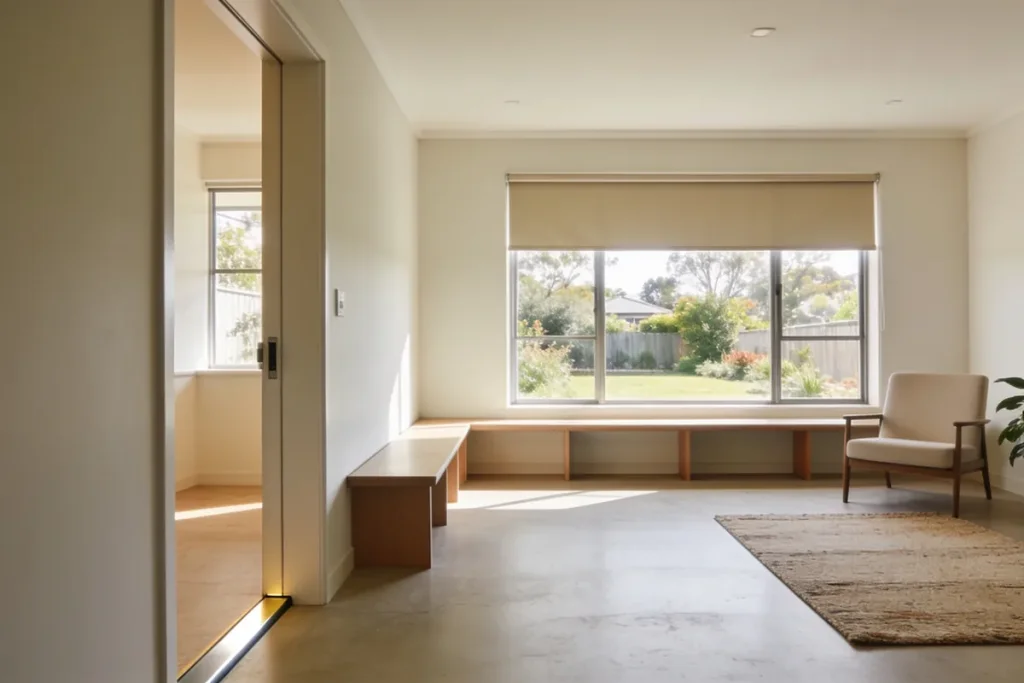
- SDA funds the home, not the support. It pays for the dwelling itself, for a small group of participants with very high needs.
- Other than SDA, the NDIS does not fund housing. That one line reframes what the scheme can and cannot do for you.
- The eligibility bar is strict, and most people who ask about SDA will not qualify. That is not a judgement of need.
- The four design categories describe what a home is built to do. The category on a listing should match the dwelling’s enrolment.
- The money has three parts: SDA funding pays the provider, SIL funding pays the carers, and the participant pays rent and bills.
Specialist disability accommodation is the most misunderstood corner of the NDIS, and the misunderstanding runs in both directions. Families ask about SDA expecting it to solve housing and support together. What the scheme actually funds is narrower and, once you understand it, clearer. SDA is capital funding for a dwelling, for participants with extreme functional impairment or very high support needs, where other home and living supports cannot meet those needs. The scheme’s own bluntest line is the best place to start: other than SDA, the NDIS does not fund housing. Everything else about SDA follows from that sentence.
What SDA is, and what it is not
SDA is a range of housing, purpose-designed or modified, for people with extreme functional impairment or very high support needs. It is the right support, in the scheme’s terms, when other home and living supports do not meet the person’s disability needs. That is the scheme’s own framing, and the wording is doing real work: this is about what a home must provide, not about what support a person needs.
In practice, SDA looks like the things that make a home workable when a disability is profound. Wide doorways and step-free access. A kitchen bench at the right height for a wheelchair. Ceiling hoists. Doors that open at the press of a button. It is ordinary housing with specific capacity built into it, and the design is the point.
Then there is the boundary, and this is the part to hold on to. Personal care is not SDA. Supported independent living is not SDA. Individualised living options are not SDA. Assistive technology is not SDA. Each is a separate support with its own funding, and the scheme says so plainly: apart from SDA, the NDIS does not fund housing at all. The site’s how the NDIS funds support: core, capacity building and capital explained shows where a capital support like SDA sits in a plan, and why it does not behave like the rest of the budget.
What each of those separate supports does is worth one line, because the mix-ups are common. Personal care is help with the tasks of daily living, such as showering and dressing. Supported independent living is the support that helps a person live in their own home, from cooking to appointments. Individualised living options are a designed model of support, built around how a person wants to live. Assistive technology is the equipment and devices that close specific gaps. None of them is the building, and the building does not include any of them.
If this article does one thing, let it be that separation. SDA is the dwelling. Everything else is something else.
The eligibility bar, honestly
Here is the sentence most pages leave out: most people who ask about SDA will not qualify. The test is written as extreme functional impairment or very high support needs, and it is applied strictly.
The reader threads on this topic are full of the same story. Someone with a real disability, real support needs, and a walker or a mobility scooter asks whether they qualify. The answers from people who have been through the process come back consistent: unlikely, because the bar sits above that, and the question decision-makers are actually asking is whether a standard home is unsuitable for the person’s support needs. That is not a judgement of anyone’s need; it is what the scheme was built to fund, and knowing it early saves months.
What does help is evidence, and there is one step that comes up again and again: an occupational therapist’s home and living assessment. A professional assessment of how the person functions at home, and what a suitable home would need to contain, is the document that argues the case. It is worth more than any description written under pressure at the kitchen table.
What that assessment contains is worth knowing before you book one. It is not a medical test in the usual sense. It looks at how the person functions across an ordinary day: what they can do unaided, what they need help with, what equipment they already use, and what a home would need to contain for their support needs to be met. It is detailed and practical, and it is written in the language of daily life, not diagnosis. That is why it carries weight: it answers the question decision-makers are asking, which is whether an ordinary home can meet the person’s needs.
Two things follow. First, a provider cannot decide eligibility for you, and no honest provider will promise it. Second, a refusal is common, and it is not the end of the housing conversation; it just moves it to a different support, which this article covers later.
The four design categories
When a dwelling is enrolled as SDA, it is enrolled in one of four design categories. The categories describe what the home is built to support, and they are the first thing to match against the person’s actual needs.
Improved liveability is for dwellings that make it easier to find your way around: things like easy-to-see walls and floors, clear sightlines, and better lighting.
Fully accessible is for homes built around wheelchair use: step-free access throughout, accessible kitchen and bathroom fittings, and room to move.
Robust is for homes built to withstand heavy use, including where complex behaviours are a factor: durable walls, fittings and floors that survive what daily life asks of them.
High physical support is the most complex category: ceiling hoists, backup power, and home automation among the features, for people with very high physical support needs.
The categories exist to be matched, not collected. A person whose needs are met by a fully accessible home and a person who needs robust construction because of complex behaviours are two different participants with two different dwellings. The category to look for is the one that reflects the support needs that were funded, not the largest or the newest home on a list.
One practical point sits under all four. A home must be enrolled by a registered provider and approved as an SDA dwelling, and the category is part of that enrolment. So the category on a listing is a claim about the dwelling, and it is a claim you can ask to see verified rather than take on trust.
SDA versus SIL: who pays for what
This is the question families bring most often, and the answer is a clean split once it is laid out.
SDA funding pays the SDA provider for the dwelling. SIL funding pays for the carers and the support delivered in the home. The participant pays rent and bills, like any other householder.
That split answers most of the confusion. SDA does not include the support. SIL does not include the building. And neither pays your rent. The three parts are separate streams that together make the living arrangement work.
In practice, the split has a few consequences worth knowing. The SDA payment flows to the provider rather than to the participant, which is why the plan records who the provider is. Rent and bills sit in the agreement between the participant and the provider, and they are worth reading as carefully as the funding papers. And because the streams are separate, a change in one does not automatically change the others: support hours can move without the dwelling changing.
Most SDA arrangements are shared: a small number of people live in the house, each with their own bedroom, and the design and the support are set up around that. Some participants share with a partner where that is the best arrangement, and some live on their own. The right shape depends on the person, not on the template.
The site’s SIL funding explained, and how to choose a provider owns the support side of the split. Keep the two straight, and the paperwork stops being a puzzle.
Finding a place, and what a vacancy really is
You find SDA vacancies in a few ways, and none of them is a queue you simply join.
The scheme publishes its own way to search for SDA vacancies, and that is the starting point. Beyond it, referrals come through a support coordinator or a recovery coach, whose job includes helping participants navigate exactly this process; the site’s NDIS support coordination: what it is and why you need it explains what that help involves. Word of mouth in participant networks is another route, and the providers themselves publish listings that are worth watching.
The honest part: vacancies are location-specific and thin. They depend on where you need to be, on the category of dwelling you need, and on who is moving out when. A vacancy five suburbs away is not a vacancy. And a vacancy in the wrong category is not a vacancy either, because the dwelling has to suit the support needs that were funded.
One documentation point is worth carrying into the process. The participant records their SDA provider in their plan, and that record is what makes the funding flow to the right place. Where the dwelling and the support are delivered by the same organisation, as they are by a registered NDIS provider that delivers supported independent living and specialist disability accommodation, that record is straightforward. Where they are two organisations, both records matter.
When a listing does appear, read it the way you would read a rental advertisement. The design category should be stated, the enrolment should be checkable, the support arrangement should be described in terms of who is there and when, and the word “available” should come with a date. A listing that cannot answer those points in writing is not yet a vacancy you can plan around.
If SDA is not the answer
For most people who read this far, SDA will not be the answer, and the useful thing is to know what is.
SIL funding is the main path for support at home: carers, daily living help, and the routines that make independence work. The site’s how SIL providers boost independence at home looks at what that support delivers in practice.
Individualised living options are the other home and living model: support built around how a person wants to live, including host and housemate arrangements, instead of around a shared house. Home modifications through the plan can change what an existing home can do, and assistive technology can close specific gaps. For housing itself, when SDA and the NDIS can go no further, the state and territory housing systems are where affordable housing questions land, and the scheme’s own guidance points people in that direction.
Each of those paths has its own mechanics, and it is worth pursuing them in parallel rather than in sequence. A home modification application does not stop a housing application, and an assistive technology request does not wait on a plan review. The scheme’s own guidance sets out how the home and living supports fit together, and a support coordinator can hold the pieces while a family works through the options. What it should not produce is a person staying in a home that does not work for them because the only question pursued was the SDA one.
None of these is a consolation prize. They are the supports that were designed for the situation, and they can change: a plan is reassessed as circumstances change, and a change in circumstances can reopen a question that was closed.
The questions to ask before you look at a vacancy
Bring these to any conversation about an SDA vacancy, and bring them in writing if you can.
- Is this dwelling enrolled as SDA, and in which design category?
- What support will be in the home, who provides it, and how is it funded?
- What do I pay for out of my own money: rent, bills, food, and what else?
- What are the house rules, and how are decisions made with the other residents?
- Who do I raise a problem with, and what happens if it is not resolved?
- Can I see the agreement before I commit to anything?
Two things belong beside the list. Take the occupational therapy assessment with you, and take the people who know you. Eligibility is argued with evidence, not with need, and it is argued better by someone who is not doing it alone.
Sources consulted: NDIS specialist disability accommodation information; NDIS guide to home and living options; NDIS Quality and Safeguards Commission provider registration information.