


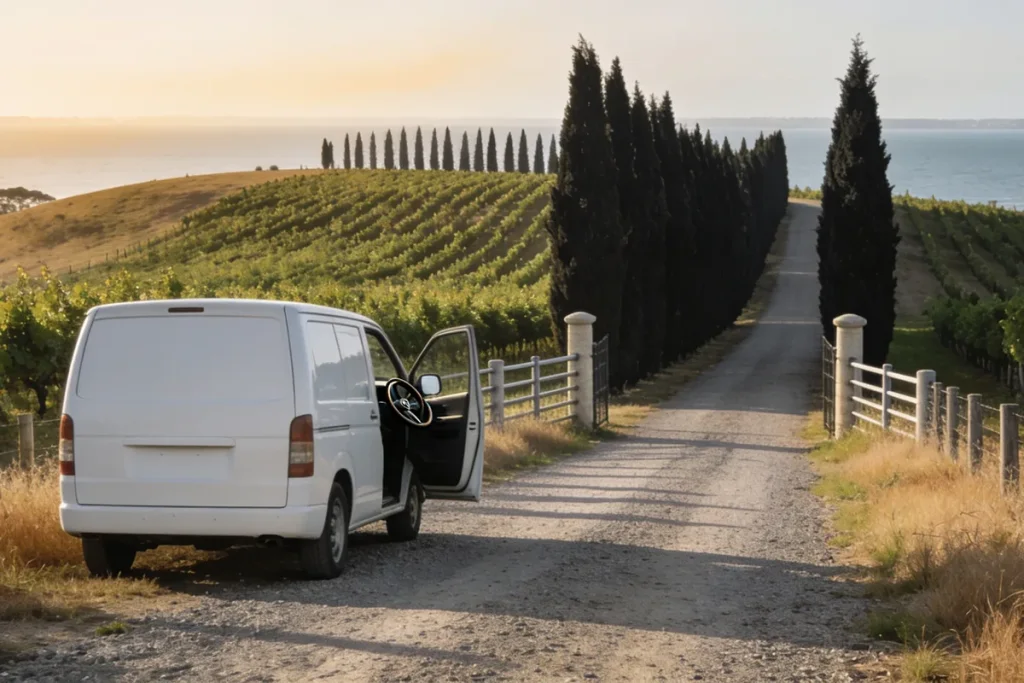
- The Peninsula is a brilliant group day out and a hard group drive, and the difference between the two is planning rather than luck.
- Six cars make the day worse, not easier. One person ends up on duty the whole time, and the convoy stops being a group somewhere around the second set of traffic lights.
- Three decisions come before any booking: how many people, what time the day actually ends, and the address and door for every stop.
- A Peninsula day has a shape. Two or three stops, one proper meal, and an afternoon that can drop its last stop without the day falling apart.
- The return leg is what decides how the day gets remembered. Book it when you book the outward trip, not at eleven at night.
So the group chat has picked a weekend, and everyone has agreed on the Peninsula. What nobody has agreed on yet is how eight adults, three stops and one long afternoon actually fit together, and that is the part you have just volunteered to solve by reading this. Take heart: the job is smaller than it looks. The trick is to plan the day backwards from its ending, because the return leg is the piece that decides everything in front of it.
The day sheet
Fill this in with the group before you book anything. It is the list of who is riding with whom, where each stop is, and the two times the day cannot move.
If this does not load: write down how many people are coming, who needs to travel together, the address and the door for each stop, the time the day starts, and the time it has to finish.
Stop 1
Stop 2
Stop 3
Stop 4
Book the return leg when you book the outward one.
Planning sheet only. Confirm the details, the vehicle and the times with whoever is driving you.
Nothing on this sheet is calculated for you. Every entry is yours.
The problem with six cars
The group that drives itself is not a bad idea. It is just a different day from the one everybody thinks they have agreed to.
If one person is driving, that person is having a different afternoon from the rest of the group. They are the one watching the clock, counting tastings, and shepherding everyone back to the car park while the others are still deciding. Nobody thanks them for it, and they are too polite to say so, which is how the same person ends up driving every year.
Then there is the parking, and on a busy weekend the parking is the plan. Small car parks fill early. A group arriving in three cars takes the spaces the next three tables wanted, and the third car is often still circling when the first two are seated. Between the drive and the search, the day loses its shape before the first stop.
And the convoy quietly stops being a group. The first car arrives and holds a table. The second one misses a turn. The third one finds the car park full and is told to wait in the street. By the time everyone is in the same place, somebody is annoyed, and the day has spent an hour of itself getting there.
This is not an argument against anybody’s driving. It is the reason the region’s own visitors keep asking how to do a day like this without a car. It is the one thing that lets everyone have the same day.
The question of whether the second car earns its keep in ordinary weeks is a household sums problem, and the site’s the second car that never gets driven: when taxis and car hire are cheaper works through it properly. For one day, with eight people, the shape of the problem is different.
The three decisions that come first
Most groups book something and then discover they needed to decide something. Working in this order saves that conversation.
How many people, and who is riding with whom. Eight people is a different day from four, because eight people do not fit in one ordinary car and should not be split across two if they want to arrive together. Decide who is travelling together before you look at vehicles, because the vehicle follows from the answer.
What time the day starts, and much more importantly, what time it ends. A booking has a finish time. A group that has not agreed one will spend the last hour of its day arguing about it in a car park, and the argument will not be about the transport. It will be about the fact that nobody said it out loud. Pick the finish time first.
The addresses. A cellar door, a restaurant and a holiday house are three different kinds of pickup point, and a driver needs an address and a door for each, not a business name. This is the least glamorous of the three decisions and the one that most reliably rescues the day, because a driver who knows exactly where to stop does not need the group to be ready at the kerb, and a group that is ready at the kerb does not stand around while somebody rings around.
This is the point at which everyone finds out the day is actually being organised. These three answers are also the only things a booking really needs.
The shape of a Peninsula day
A day out here is a rhythm, not an itinerary. Get the rhythm right and the day flexes around it.
Two or three stops is a day. Five is a blur. Past the third stop, nobody can reliably tell the pinot from the chardonnay, and the group photographs get worse. The stops worth keeping are the ones people will remember, rarely the ones crammed in at the end.
One proper meal is the anchor. Lunch is what the whole day is built around, and it deserves to be booked before the transport is, because a table is harder to move than a car. Once the meal has a time and a place, the rest of the day has somewhere to hang.
The afternoon flexes. As you plan, nominate the stop the group would be happiest to lose if the day runs long. That single decision prevents the worst end to a group day, which is rushing somewhere nobody wanted to go so that nobody has to admit the plan was too big.
And the region is longer than it looks. The ridge towns and the coast towns all sit under the one name, and they are not next door to each other. A day that starts among the vines and ends by the water is a real drive, and the group feels that drive at the end of the day rather than the start. Let the day have one centre of gravity.
How a group actually splits into vehicles
One maxi moves the whole group together, and it turns the return leg into one booking instead of three. A maxi is simply a taxi that seats the whole group, and the booking behaves like any other booking: it can be changed, moved or made later. It also means the day moves at the group’s pace rather than the slowest car park’s. The site’s is your current travel option saving you time and effort? is about ordinary weeks rather than big days, but the maths is the same one: time a group spends on the road is time it is not spending at the stops.
Sometimes one vehicle is not the right answer. When half the group wants the water and half wants the long lunch, the answer is one vehicle plus a second car, and the limit is that one vehicle cannot be in two places at once. An unagreed split becomes two bookings or one decision. Make it a decision.
Group gear needs saying out loud too. A group coming straight from a holiday house, or carrying prams, or dressed for something later, needs boot space, and boot space is a conversation at the time of booking rather than a surprise at the kerb.
Accessibility works the same way. A wheelchair accessible vehicle is available, and it has to be requested when the booking is made, not mentioned on the night. Say what the group actually needs when you book, and it is simply part of the arrangement. This is the kind of booking a Mornington Peninsula taxi service with maxis and wheelchair accessible vehicles takes as a matter of routine.
There is one rule that settles half these debates: the vehicle is chosen for the least flexible person in the group, not the most.
The return leg is what decides the day
Everyone plans the arrival. Almost nobody plans the way home, and the way home is where group days go wrong.
The whole Peninsula empties at roughly the same time as your group does. The venue roads fill, the pickup points get crowded, and the phones are all at fifteen per cent. Three things make that hour survivable.
Book the return when you book the outward trip. The second call is the one nobody makes, and the difference between having made it and not having made it is the difference between walking to a waiting car and standing in a dark car park.
Pick the pickup point in daylight. A cellar door’s driveway is not a rank, and a group waiting on the wrong side of a country road is how an evening ends badly. Agree the exact spot in the morning, while everyone can see it.
Agree the finish time with the group, not with the driver. The booking is only as good as the group’s willingness to leave, and the group’s willingness is decided at lunch, not at eleven at night. If the plan is to keep going somewhere else afterwards, say so when you book, because a group that is staying on the Peninsula for the night has a different ending from a group heading home. Both are fine. Only one of them was booked.
The site’s getting home after dark: when a cab is worth it over public transport looks at why the end of an evening is its own planning problem. The group version is the one where five people are deciding together, which is why it goes wrong more often.
The other group days the Peninsula does
The same three decisions run the whole region’s social calendar.
Weddings. The region is a wedding destination, and the hard part is never the ceremony. It is moving guests between a venue and accommodation that are not near each other, at an hour when everyone is happy and nobody wants to leave.
Birthdays and work socials. Fixed start, fixed finish, one address at each end, and usually one organiser quietly holding all of it. Same decisions, happier enforcement.
And the days where the group splits. Half the group wants the water, half wants something else, and the split becomes the vehicle question from earlier in this article, arriving in person. Groups survive this fine when it is decided in advance, and badly when it is discovered at the kerb.
What to sort out the night before
For whoever is holding the booking.
- Who is in which vehicle, by name, not by “we’ll sort it out”.
- The address and the door for every stop, written down rather than remembered.
- The two times that cannot move: the booking’s start, and the booking’s finish.
- How many seats are actually needed, and whether anyone needs an accessible vehicle or extra boot space.
- The driver’s number saved in every phone before the day, not searched for at the kerb.
- One person named as the one who holds the plan, so there is one answer to every question.
A group day works when one person holds the plan and everybody else only has to be ready on time. You are already that person. The rest is a booking and a list.
Sources consulted: Visit Victoria Mornington Peninsula wineries information.