


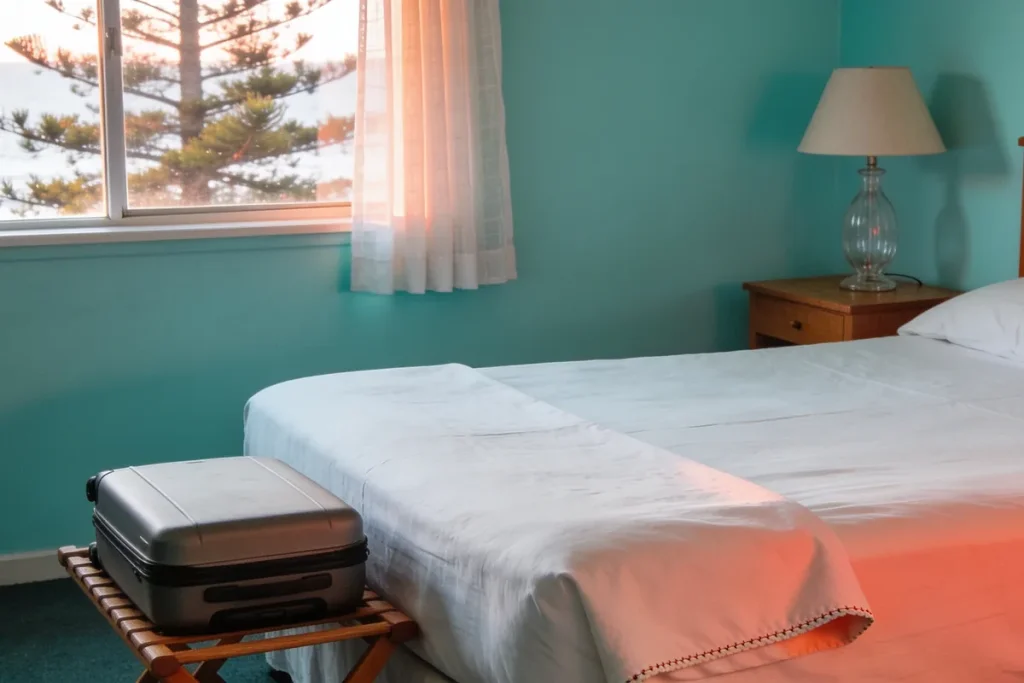
Picture the moment you arrive. You wheel the suitcase into the room, the light through the sheer curtain is soft, and the bed looks freshly made. The nearest flat surface for the bag is that bed, so up it goes. It is a small, ordinary habit, and it is the one worth changing. This post covers the five-minute check to do first, what to do if you find bed bugs, what the consumer guarantees say about the nights you paid for, luggage and laundry, and why a bug bomb is not the fix. The checklist below puts the routine in one place.
Your bed bug checklist for a stay
0 of 18Before you book
At check-in
If I find one
Back home
Our position has three parts. Check the mattress seams before you unpack, because bites prove nothing: as many as one in five people do not react at all, and a reaction can take days to show. If you find bed bugs, document them and ask in writing for the unused nights back, because a stay with bed bugs is the kind of problem the consumer guarantees guide treats as a major failure. And at home, leave treatment to a licensed pest manager rather than a bug bomb, because the health departments we read say sprays miss eggs, repeat visits are needed and an inaccurate space spray can scatter the bugs, and one Victorian technical note (updated January 2018) thinks insecticide resistance is the main reason infestations have increased.
This is general information, not medical, pest-control or legal advice. Every figure below is attributed to the official page it comes from, as that page stood on 19 November 2026, apart from two figures from a commercial guide that the heat section names as such.
Look for the bug, not the bite
Bites feel like the obvious clue, and they are a poor one. Healthdirect says as many as one in five people do not react to bed bug bites, and Healthy WA says much the same. A reaction can also be slow: both pages say up to nine days, and the Victorian Department of Health technical note (updated January 2018) gives nine to 14. So a night without a bite proves nothing, and an itchy morning does not tell you the cause.
Look for the bug instead. Start with the mattress, particularly along the seams and stitched edges, because the Victorian note says early infestations sit at the seams, beading and folds of mattresses. Then check the bed frame, headboard and bedside furniture, picture frames, wallpaper edges, carpet edges and skirting, which is the list Healthy WA gives.
The Better Health Channel names hotels, motels and hostels as the most common places. Healthdirect points to low-cost short-stay accommodation but says bed bugs “can be anywhere you sleep”. It is not a hygiene failing, either. The Better Health Channel says any household can be invaded, that high standards of hygiene alone are unlikely to control an infestation, and that a clean house makes them easier to spot early.
The five-minute room check, in order
Here is the check as a sequence, with a hypothetical room to hang it on. The bag stays off the bed until you have looked. That is our advice rather than a line from a health page, and it costs nothing.
Lift the corner of the sheet and run your eye along the mattress seam and the stitched edge, working down one side. You are looking for small dark or rusty spots, which are bug excrement; bloodstains on the sheet, which can come from crushed bugs; shed skins; tiny white eggs, about one millimetre according to healthdirect; and live bugs, which healthdirect describes as oval and up to six millimetres long as adults (the Victorian note gives one to five millimetres). When there are many, there can be a sweet, musty smell. The bugs are quick to flee light, the Victorian note says, so a quick glance may miss them.
Then move to the bed head, the frame and the bedside table, and finish with the wall behind the bed and the carpet edge. Think of it as the room’s version of checking a hire car over before you accept the keys: a few minutes at the start, so nobody argues later about what was there. Check your luggage on arrival and again before you leave, as Healthy WA advises. And do not let a quiet night talk you out of the check, because no bites tells you nothing.
If you find one: the order
Say your thumb runs along the seam and catches a cluster of dark spots, and then something small moves. This is a moment to slow down. Here is the order we would follow.
- Stop unpacking and keep the bags closed. The Victorian note says bed bugs hitchhike in luggage and clothing, so a closed bag is your first line.
- Photograph what you found, with the bed or room in the frame. A close-up alone does not show where it was.
- Tell the property in writing, by email or through the booking platform’s messages, and keep a copy. A chat at the desk leaves nothing to point to later.
- Ask for what you want in the same message: a refund for the unused nights, or compensation for the difference in value. The next section explains those two terms.
- Ask that any new room be checked and is not next door. The Victorian note says adjoining rooms need inspecting, so this is our suggestion built on it.
- Keep receipts for any extra cost.
A plain message is enough: “I found bed bugs along the mattress seam in room [number] on [date]. Photos are attached. I would like a refund for the unused nights, or compensation for the difference in value.” And one thing not to do: do not spray or set off a bomb in a room you do not own. Treatment is a job for a licensed pest manager, as the section on bug bombs explains.
Your rights when the room is infested
This is the step the pest-control guide we read left out, so we will be exact. The reference is the Travel and accommodation industry guide to the Australian Consumer Law, developed by the ACCC and every state and territory regulator and published in 2013, in the copy hosted by Consumer Affairs Victoria. It says the consumer guarantees apply to services and “cannot be excluded, even by agreement”.
A failure is major where, in the guide’s words, “a reasonable consumer would not have acquired the services if they had known the nature and extent of the problem”. The guide’s own example is a holiday rental infested with mice. It does not mention bed bugs, so this is an analogy, but a room with bed bugs is the kind of problem the guide describes as a major failure. The ACCC page points the same way, describing a problem that would stop someone buying the service if they knew about it beforehand.
For a major failure, the guide says the consumer chooses, not the supplier. You can cancel and get a refund for any unconsumed services, and the guide’s example is “the unused nights of a hotel stay”. Or you can keep the contract and get compensation for the difference in value. The ACCC cautions that a refund “may not be a full refund”, so the realistic ask is the nights you did not use.
A minor problem is handled differently. The guide’s example is a missing cot, and the business gets a chance to fix it free of charge in a reasonable time. If it will not, or takes too long, other remedies open up. Where bed bugs fall depends on the facts: how many, how quickly the property responded and what the booking terms say. We cannot promise an outcome, and we have not checked how platform bookings behave, so read those terms.
If the business refuses, the next stop is your state or territory consumer protection agency. The ACCC says it does not resolve individual disputes, but it accepts reports and explains the guarantees. Your photographs, written report and receipts are the record that helps there.
Luggage and laundry
Heat is the household answer, and the official figures differ slightly, so here they are together.
| What | Figure | Source |
|---|---|---|
| Wash water | Above 60 degrees | healthdirect |
| Tumble dry | On hot, at least 30 minutes | healthdirect; Victorian note |
| Tumble dry | On high, at least 40 minutes | Healthy WA |
| How fast heat kills | Within an hour above 45 degrees; immediately at 60 degrees or higher | healthdirect; Victorian note |
Our ruling: use the official figures, take the longer dryer time, and read the care label first. One commercial guide we read gives 45 degrees for an hour in one place and about 50 in its FAQ, so the numbers do drift. A hot wash and a long hot dry will suit some fabrics and spoil others. If a label rules out the heat, that is a question for a pest manager, not a guess.
Two details help. The Victorian note warns that gradual, slow heating of an infested area makes the bugs migrate away from the heat. Applying that to laundry is our inference: a short hot cycle looks the better choice over a long warm one. It also says steam kills all stages and suits seams and crevices, which is an option on your own mattress at home.
Where you unpack matters as much as how you wash. Empty bags outside or in the laundry rather than the bedroom; that is our advice, not a health page’s. For second-hand furniture, healthdirect says to inspect it before you bring it inside.
Why a bug bomb is the wrong tool
Search for what to do and you will hear a few positions online. One is to check the seams, hot-dry everything and hire a professional. Another is to try heat or steam first for a small find. A third is to reach for a shop-bought spray, powder or bug bomb and hope. We cannot say how common each is, and we do not need to, because the official pages answer the question.
No Australian official page we read names bug bombs or foggers, so we will not claim anyone has tested them. What the pages do say is this.
- Treatment is a job for a licensed pest manager. The Better Health Channel says a professional can assess and use registered pesticides, and that repeat visits may be needed. Healthdirect says eggs can survive the first treatment and that delay lets the problem spread and cost more.
- The Victorian note says insecticide resistance is thought to be the main reason infestations had increased in the ten years to 2018, and that modern bed bugs are highly resilient to many commonly used insecticides. It adds that complete eradication is “unlikely to be achieved with a single treatment”, and that sprays “may kill the bed bugs but they are largely ineffective on the eggs”. A follow-up visit comes in about a week.
- Healthy WA says the residual products it describes are designed for surfaces and “should not be used as space sprays”, and that regular pesticides do not kill bed bug eggs. The Victorian note warns that if an operator completes an inaccurate space spray, the droplets “can excite the bed bugs” and “can disperse the infestation to other areas”.
Here is our inference, not a quotation from any page: a bug bomb releases pesticide into the air of a room, which makes it a space spray. If that is right, the Victorian note’s warning about an inaccurate space spray is the closest caution. Healthy WA’s line is about its surface products and does not name foggers, and neither page tests a bomb. That is why we say a bug bomb is not the fix, rather than claiming it will fail.
The other side has a fair point. Treatment is a real cost, and early, single-bug finds can start with heat and steam, as above. The Better Health Channel also allows spraying hiding spots with a surface pesticide registered for bedbugs, following the label carefully and never on bedding. Nobody has to panic-buy a professional on day one. But that is a targeted job, and in our reading quite different from filling a room.
When you do hire, check the licence. In Victoria that is a Pest Control Licence under the Public Health and Wellbeing Act 2008. In Western Australia the business must be registered with the Department of Health and the work done by a licensed technician. Ask for the full chemical name of the pesticide, as the Better Health Channel suggests, and expect to leave while it is applied and drying, generally four to six hours, with the operator advising. Our guide to pest problems in Melbourne has a section on how to choose a pest controller.
Home after a stay, or after a second-hand buy
When you get home, the bags go to the laundry or outside, not the bedroom. Wash and dry what you can, using the heat settings above after checking each care label, and look along your own mattress seams over the next few weeks. If you find any, call a licensed pest manager and leave the bomb on the shelf. The routine fits alongside the rest of your trip preparation, such as the habits in our long-haul flight tips. A second-hand bed or couch gets the same check before it comes through the door. And if it does happen, it is not a sign of a dirty home: the Better Health Channel says any household can be invaded.
The room first, the suitcase second
Check the seams before the bag leaves the floor. If you find bed bugs, photograph them, report in writing and ask for the unused nights, because the consumer guarantees guide treats that kind of problem as a major failure, though the outcome depends on the facts. At home, hand treatment to a licensed pest manager, because the health pages point to repeat visits, a licensed professional and a warning against inaccurate space spraying, and in our reading a single bomb does not fit that picture. The other side’s fair point is cost, and it is a good reason to start with heat and steam on a small find, never a reason to skip the check.
Sources: Bedbugs, Better Health Channel, Victorian Department of Health (https://www.betterhealth.vic.gov.au/health/conditionsandtreatments/bedbugs); Bed bugs, healthdirect (https://www.healthdirect.gov.au/accidents-and-injuries/bites-and-stings/bed-bugs); Bed bugs, Healthy WA, WA Department of Health (https://www.healthywa.health.wa.gov.au/Articles/A_E/Bed-bugs); Pest control technical note 18, Bed Bugs, Victorian Department of Health (https://www.health.vic.gov.au/sites/default/files/migrated/files/collections/policies-and-guidelines/p/technical-note-number-18—bed-bugs.pdf); Pest control services, Better Health Channel (https://www.betterhealth.vic.gov.au/health/healthyliving/pest-control-services); Guide to selecting a pest management business, Healthy WA (https://www.healthywa.health.wa.gov.au/Articles/F_I/Guide-to-selecting-a-pest-management-business); Travel and accommodation: an industry guide to the Australian Consumer Law, Consumer Affairs Victoria (https://www.consumer.vic.gov.au/library/publications/businesses/fair-trading/travel-and-accommodation-an-industry-guide-to-the-australian-consumer-law.pdf); Repair, replace, refund, cancel, Australian Competition and Consumer Commission (https://www.accc.gov.au/consumers/problem-with-a-product-or-service-you-bought/repair-replace-refund-cancel)