


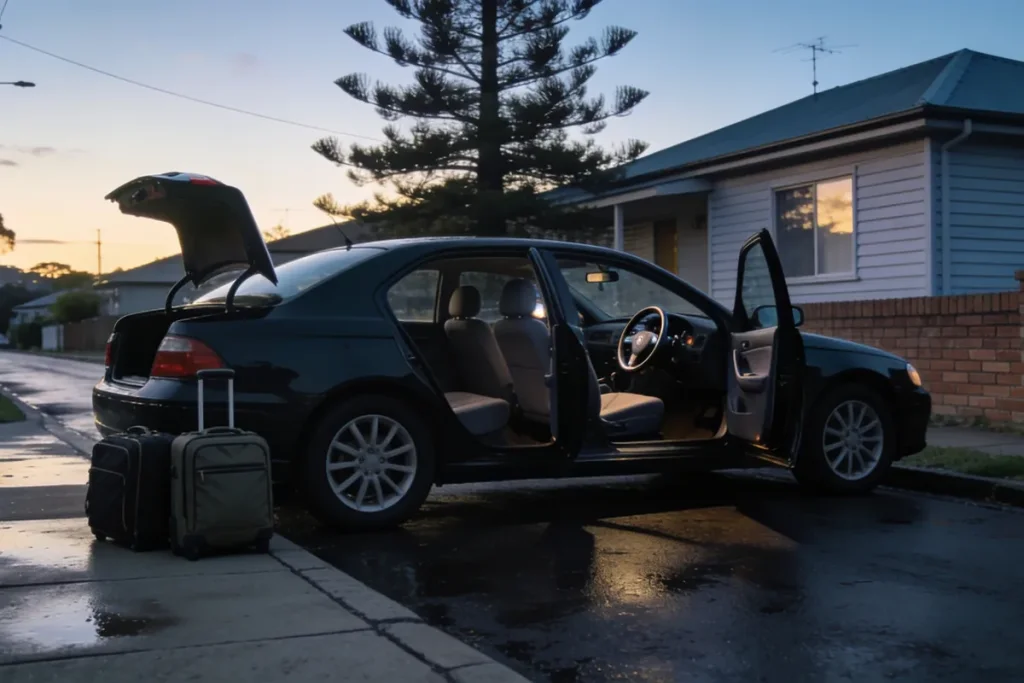
- Two questions decide an airport run: which airport your flight leaves from, and what time the car has to be outside. Everything else follows from those answers.
- Melbourne has two airports on opposite sides of the city. Melbourne Airport sits at Tullamarine to the north-west, and Avalon sits near Lara to the south-west, with its own routes and its own international services.
- The check-in window belongs to the airline. Ask for it, and work backwards from it rather than guessing it.
- Public transport to the airports works well within the hours it runs. A transfer is not competing with it on price. It sells a door, a time, and a driver who knows what the flight is doing.
- A pre-booked transfer changes the fare, the pickup time, and who moves first when a flight is delayed. It does not change the road, the queues, or a tight connection.
Most airport planning begins with the wrong question. The question that gets asked is which company to book, and it is asked before the one that matters: which airport the flight actually uses. The method in this article runs in the opposite direction to instinct. It starts at the departure time on the ticket and works backwards through the check-in window, the bag drop, the security queue and the drive, so that the time the car is needed falls out of the arithmetic at the end rather than being chosen at the start.
What time do you need to leave?
Enter your flight time and your own check-in window, and this works out the two times that matter: when to be at the terminal, and when the car has to be outside. The check-in window comes from your airline, not from here.
Your airline's own guidance, not a default from this page.
Morning peak and Friday afternoons are the ones that catch people.
Planning arithmetic only. Check your flight time and your check-in window with your airline, and confirm the fare and the pickup details with whoever is driving you.
No fares, no travel times and no check-in windows are calculated or suggested here. Every number above is yours.
Two airports, two different journeys
Melbourne Airport, at Tullamarine, is the larger of the two and the one most fares are quoted against. It sits north-west of the city on the Tullamarine Freeway side, and it carries the bulk of the domestic and international traffic that arrives in Melbourne. Avalon Airport is the second, south-west of the city near Lara on the Geelong side, and it is not a satellite strip with a single destination list. It runs its own route network, including international services, and its own published information separates flights, parking and transport onto different pages, which says something in itself about how many ways there are to reach it.
For a reader living west or north of the city, including Bacchus Marsh, Melton and the towns around them, the choice between the two is genuinely live. For a reader in the inner suburbs it rarely is, because the two airports lie a long way away in different directions. The honest rule is simple: which airport you should be looking at depends on which one your airline actually flies from. That is a question about your route rather than about distance, and it is answered by the ticket rather than by a map. For anyone outside the metropolitan ring, it makes the airport choice something to check rather than a habit to keep. No driving time is offered here for either airport, because the number that matters is the one your own trip produces on the day, not an average.
One piece of the airport’s own advice is worth repeating. Melbourne Airport states that taxi ranks are located close to all terminals, that passengers should use the marked ranks only, and that informal offers of a ride should be declined. That is sound advice at either end of the day, whichever airport the flight uses.
The first decision is not the airport, it is the flight
The flight comes before the airport, and the flight number comes before the flight. A route alone is not enough, because airlines move services between airports and schedules change with the seasons. The flight number on the ticket settles both the airport and the terminal, and it is the one detail on which every later step depends.
Then the fare class and the bag. A checked bag changes how early the counter needs you, because bag drop has its own queue and its own cut-off, and travelling with carry-on only changes it back. This is the step where most people lose twenty minutes, and they lose it because the airport was settled before the flight was checked against the ticket. Read the ticket first. It answers the question without any guesswork.
Working backwards: the method, in four numbers
Working backwards takes one time and four subtractions. Take the departure time on the ticket. Subtract the check-in window your airline recommends for your flight. Subtract your own buffer for bag drop and security. Subtract the drive, and subtract a margin for traffic. What remains is the time the car has to be outside. The check-in window is the airline’s to give, and it differs by carrier, by route, and by whether the flight is domestic or international. This article will not guess it, and any page that offers one figure for every flight is guessing.
Two features of the Australian version are worth holding on to. The first is that the airport is not one queue but three: check-in, bag drop and security screening are separate queues with separate waits, and a quiet morning at one says nothing about the others. The second is that the road to Tullamarine has no reliable off-peak. A run that feels empty on a Sunday can be heavy on a weekday morning, and Friday afternoons are their own category. The margin for traffic is not padding. It is the part of the arithmetic that assumes the road behaves like a road, and it is why the sum is worth doing twice: once for the morning you are hoping for, and once for an ordinary weekday.
When the train or the bus actually wins
Public transport to the airports is real and it works, within the hours it runs. There is a commercial airport bus service, and there are rail and bus routes that connect to the terminals. For a reader in the inner suburbs with one bag and a civilised departure time, they are cheaper than a car and often perfectly fine. It would be dishonest to suggest otherwise, and no fare comparison is needed to make the point.
They stop winning in four situations. The first is a flight that leaves before the first service of the day. The second is travelling with children, or with more luggage than one person can manage on stairs. The third is a suburb with no practical connection to either airport, which is more of the city than the route maps suggest. The fourth is a regional town, where the hard part is not the airport leg at all but the first leg: getting from Bacchus Marsh, Darley or a town like Woodend to the point where the airport service begins. That first leg is the one a local cab solves, and the site’s navigating Woodend with ease: a closer look at local cab travel looks at the same problem from a smaller town’s perspective. The site’s the second car that never gets driven: when taxis and car hire are cheaper runs the cost comparison for anyone wondering whether a trip like this justifies the vehicle sitting in the driveway.
The train is cheaper, and that is not in dispute. The question is whether its timetable fits the day you are having, and for an early flight or a late arrival it often does not. A transfer is not competing with a train on price, and it does not pretend to. It sells a door, a time, and a driver who knows what your flight is doing.
What a pre-booked transfer changes, and what it does not
A pre-booked transfer genuinely changes three things. A car is already on its way before you wake up, which removes the first uncertainty of the day. A fixed fare is agreed in advance, so the meter is not the surprise at the other end. And flight tracking means a delayed arrival becomes a moved pickup rather than a missed one, which matters most on the way home.
What it does not change is worth knowing just as clearly. It cannot beat a road closure. It does not check you in. And it cannot make a tight connection work. If the connection is the problem, the fix is an earlier flight rather than a faster car.
The questions to ask at the time of booking are practical, and a capable operator answers them without needing to be prompted. Is the fare fixed or metered? Is the price per vehicle or per person? What happens if the flight is late? How much luggage can the vehicle take, and is there a larger vehicle for more of it? Is there a child restraint available, and will it be fitted? Is the vehicle wheelchair accessible, if that is what is needed? Questions of that shape, asked before the booking rather than at the kerb, are what a Bacchus Marsh and Darley cab service that runs airport transfers to Melbourne and Avalon works through with passengers as a matter of routine. They are worth asking of any operator. The site’s taxi or your own car? why hopping in a cab might be the safer choice takes the neighbouring question, of whether to drive yourself at all, from the other direction.
The return leg, which is the one people forget
An arrival is not the reverse of a departure, and the return leg is the half people forget. Two things are booked differently. The pickup time on the way home should track the flight number rather than a timetable, so that a delay is absorbed rather than argued about. And the drop-off point matters: a terminal is not a suburb, and a driver who knows which rank or which kerb to use at the right door saves the whole arrival rather than the last ten minutes of it.
What to have in hand when you land: the booking reference, a charged phone, and the driver’s number saved before takeoff rather than searched for at the luggage carousel.
What to have ready before the pickup
The widget above is this list in working form. In prose, it comes down to seven things.
- The flight number and the airline.
- The terminal, if it is known.
- How many people are travelling, and how many bags are coming.
- Whether anyone needs a child restraint or a wheelchair accessible vehicle, requested at the time of booking.
- The exact pickup address, and which door the car should wait at.
- The time the car needs to be there, which is not the same as the time you would like to leave.
- The number you will answer on the morning of the flight.
The run is easy when the flight number is doing the work, and hard when it is not.
Sources consulted: Melbourne Airport ground transport information; Avalon Airport getting here information.