


- Four structures get called “a patio roof”, and they are not the same job: a patio, a carport, a pergola and a verandah each want something different overhead.
- Polycarbonate is for light and metal is for span and shade. Both are good at their job, and both have a weakness worth knowing before you order.
- Three questions decide the sheet: do you want light underneath, how far apart are the supports, and what is it attached to.
- The sheet is the easy line on the order. The flashing, the fixings, the gutter and the sealant are the lines people leave out and then drive back for.
The frame is up, the afternoon is going, and there is a stack of timber in the yard that was a pergola an hour ago and is now a question. What goes overhead is the decision everybody wants to make first, and it is the one that should be made last. A patio roof is a small construction with a surprising number of parts, and the sheet is only the visible one. Choose the sheet for the light you want underneath it, then order for the water you have to get rid of.
The order checklist
0 of 12Everything that has to be on the order for a patio, carport or pergola roof. Tick what you have sorted, and take the list with you.
If this does not load: sheet and profile, flashings and capping, closures, fixings and washers, frame members, gutter and downpipe, sealant, and the gear to get it up there safely.
You have sorted 0 of 12. The ones still unticked are the ones that cause a second trip.
Order list only. Confirm the material, the profile and the frame requirements with your supplier or your builder before you order.
No prices, sizes or specifications are given here. That conversation belongs at the counter.
Four structures, four different jobs
The word “patio” gets used for four different structures, and the first way to make this decision easy is to work out which one is actually in the yard.
A patio roof is attached to the house and is about living outdoors: shade, rain cover and a place to sit that is not the kitchen. A carport is about a vehicle, which means cover, ventilation and enough clear space to get the car in and out without a conversation. A pergola is an open frame that may not be roofed at all to begin with, and the roof is often added later, changing what it fixes to. A verandah is the older Australian version: a roof over a walkway, tied into the house and sending its water to a gutter that may already be doing enough work.
If you are at the front end of a bigger build, the site’s how to prep your site for a smooth concrete pour covers the ground work that happens before any frame goes up.
The structure decides the sheet, not the other way round. A person who picks a material before checking what will hold it up ends up back at the yard, and the yard is a long way to go for a conversation that could have happened at the start.
The materials, honestly
Three materials cover almost every outdoor roof in the country, and each has a job it does well and a weakness worth knowing before you spend.
Polycarbonate lets daylight through. It is light to handle, it comes in different profiles, tints and thicknesses, and it moves with temperature, which is why its fixings have to allow that movement. It is the obvious choice when the point of the roof is light: a carport workspace, a walkway, a covered area that would otherwise be gloomy. Light means heat underneath, and it is louder in rain than a solid sheet, which matters if the roof sits over a table or a bedroom window.
Steel sheet is opaque, spans further for the same thickness, and behaves itself in weather. It is the material most people picture when they say “metal”, and for most Australian patios it is the default. Its honest limitation is the mirror of polycarbonate’s: it turns the area underneath into shade, and that shade can get hot without some thought given to insulation and ventilation. A steel roof works when the ceiling of the space is planned, and disappoints when it is an afterthought.
Tiles are a house-roof material, and they need a structure designed to carry them. That is a different conversation from a patio, and it is worth having with someone before the frame is finalised rather than after.
One more thing, said plainly because it is where budgets go wrong. The cheapest sheet is often not the cheapest job, because the sheet is the part people price and the fixings, the flashings and the edge work are the part they do not. A translucent roof and a solid one can be close in cost by the time both are finished, and the difference shows up in the space at four in the afternoon. On the daylight question specifically, the site’s best skylight roofing options for homes in Melbourne’s climate takes the same argument into the roof cavity, and the site’s how to choose roofing materials for Australia’s extreme weather covers how the materials behave when the weather is doing its worst.
The three questions that decide it
A supplier will ask three questions at the counter, and a householder who has already answered them gets served in one visit. They are worth sitting with in the backyard first.
Do you want light underneath, or shade? This is not a materials question at all; it is a question about how the space will be used. A place for plants and morning coffee wants light. A place for a table in January wants shade. Answer this one honestly and the material has usually chosen itself.
How far apart are the supports? The span between the posts decides the profile and the strength of what goes across it, and a sheet that is right for one frame is wrong for another. You do not need to answer with numbers, just the actual distance written down, so the person at the counter can match it to what they stock.
What is it attached to? An existing house wall, a steel frame, or a freestanding structure: each one changes the fixing and the flashing that goes with it, and the flashing is where most of the water problems in an outdoor roof are born.
Two secondary questions come up after installation rather than at the counter. Noise, which matters if the roof is over a bedroom window or a sitting area. And heat, which matters if the space gets used in summer rather than admired from indoors.
A householder who arrives with those five answers is speaking the same language as the person serving them, and the order that comes out the other end is the right one the first time.
What else is on the order
This is the part that saves a second trip to the yard: the sheet is one line on the order, and the list below is the rest of it.
Flashings and capping, for the edges and for where the roof meets the wall. Foam closures or infill, for the ends and the profiles where the sheet shape leaves gaps. Fasteners with the right washers, matched to the material and to the movement it makes. Purlins, battens or frame members, if the structure needs them. Gutters and downpipes to take the water somewhere, because a roof that dumps onto a path is a roof that is not finished. Sealant of the right kind. And the tools and safety gear for the job, including something to stand on that is not a chair.
Then the two things that turn the list into a correct order rather than a hopeful one. Measure the actual structure rather than the plan, because the frame that is standing is the frame the roof has to fit. And take photographs of the frame, and of anything the roof has to meet, so the person at the counter can see what you can see. That is the difference between a conversation about measurements and a conversation about guesses.
Ordering it, and what the yard needs from you
The first choice is cut to length or stocked lengths. Cut-to-length orders are made to the measurements you bring, which is why the numbers matter more than the brand, and why the wait can be longer than a householder expects. Ask about that timing at the counter, because a roof that arrives late leaves the frame standing in the weather.
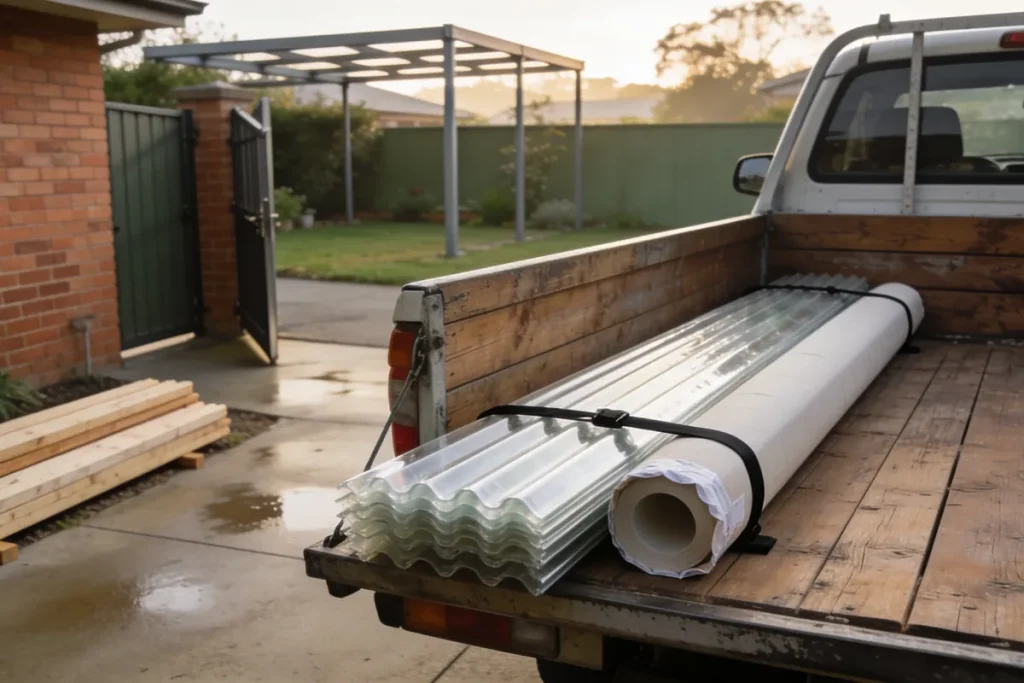
Pickup or delivery is the second. A load of sheets is long, awkward and catches wind on the drive home, so the practical questions are what you are carrying it in, whether the yard loads it, and who is unloading it at the other end. The answers decide the plan.
And one habit that saves everything: keep the profile name from the last order, if there was one, on the invoice or in a phone photo. It turns “the stuff that’s on the old carport” into a two-minute order. That is the difference between a five-minute counter visit and a twenty-minute one, and it is the kind of order a Truganina roofing supplier that stocks polycarbonate, metal and tiles with local pickup takes every day of the week.
When it is not a DIY job
Some of this work is a capable householder’s job and some of it is not, and the line between them is worth drawing honestly rather than flatteringly.
Replacing sheets on a single-storey patio, one for one, with the frame already sound and the fixings accessible: that is a job a capable householder can do, carefully, with someone else at the bottom of the ladder.
Everything else belongs with a licensed trade: working at height on a two-storey wall, tying a new roof into an existing one, anything that involves changing the structure itself, electrical work if there is going to be a light or a fan under the roof, and the stormwater connections if the new gutter has to join something underground. Most of the structures people ask about are supplied by a supplier and installed by their own builder or carpenter. If any part of the job makes you pause and look up, that is the part to hand over.
The list that saves a second trip
The compressed version, in the order the yard will ask for it.
The sheet and its profile. The flashings and capping. The closures. The fixings and washers. The frame members, if the structure needs them. The gutter and downpipe. The sealant. And the gear to get it up there safely. Measurements taken off the actual frame, a photo of what the roof has to meet, and a named person at each end of the trip home.
The sheet is one line on the order. The rest of the list is what makes it a roof.
Sources consulted: Your Home roofing materials guidance.