


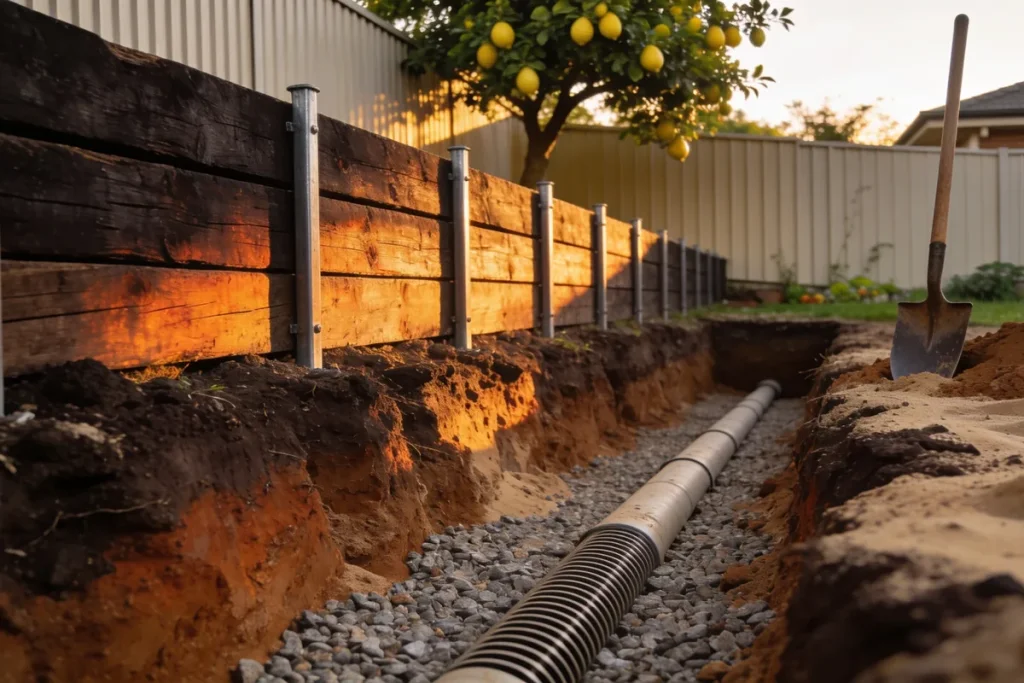
- A retaining wall is a ground and drainage project that happens to have a wall in front of it. The wall is the part you can see, and it is the cheapest part of the job.
- What holds a wall up is everything behind and under it: how the ground drains, and what the base is sitting on.
- Water is what finishes most walls. Ground that cannot drain stays wet, wet ground is heavier, and it pushes harder than the wall was built for.
- The work that prevents all of that is invisible once the job is finished, which is exactly why it is the work that gets cut.
- Nobody can diagnose a wall from a photograph, and this article will not try.
You can stand in front of a wall for twenty years and learn nothing about it. The face, the sleepers, the render, the colour: none of it tells you whether the thing will still be there in a decade, because everything that decides that is on the other side. A retaining wall is really two projects stacked together, and the visible one is the cheaper of the two. This article is about the hidden half: what a wall is actually doing, what has to be behind it, what has to be under it, and the signs that mean it is time to stop looking and get somebody to look in person.
What a wall is actually doing
Start with the job description, because most of the confusion comes from it. A retaining wall holds back ground, not water. The ground it holds is soil, and soil is at its heaviest when it is wet, which is the first thing people miss when they are picturing the problem.
The wall then has to resist the push of that ground for decades, in a place where the ground itself moves with the seasons. Nothing about that is exotic. It is just a load, carried by a structure, for a long time, in a climate that swings between dry and soaked.
Two consequences follow, and both are worth understanding before any quote. A wall on a slope is doing a different job from a wall beside a driveway, because the ground above it is pushing at a different angle and carrying different weight. And a wall that is taller, longer, or holding more ground above it is doing a different job again, even if it looks like the same wall from the street. The wall is the visible answer to a question about soil, and the soil is the part nobody photographs. The question also grows with whatever sits above: a wall holding a garden bed is answering a smaller version of the same question as a wall holding a driveway.
The thing behind the wall that keeps not being built
This is the section the whole article exists for, so it is worth reading slowly.
Water is what finishes most walls, and the mechanism is simple. Ground that cannot drain stays wet. Wet ground is heavier, and it pushes harder. A wall that was priced for dry ground is suddenly working against something much bigger than it was built for, and it was never given the means to let the pressure go.
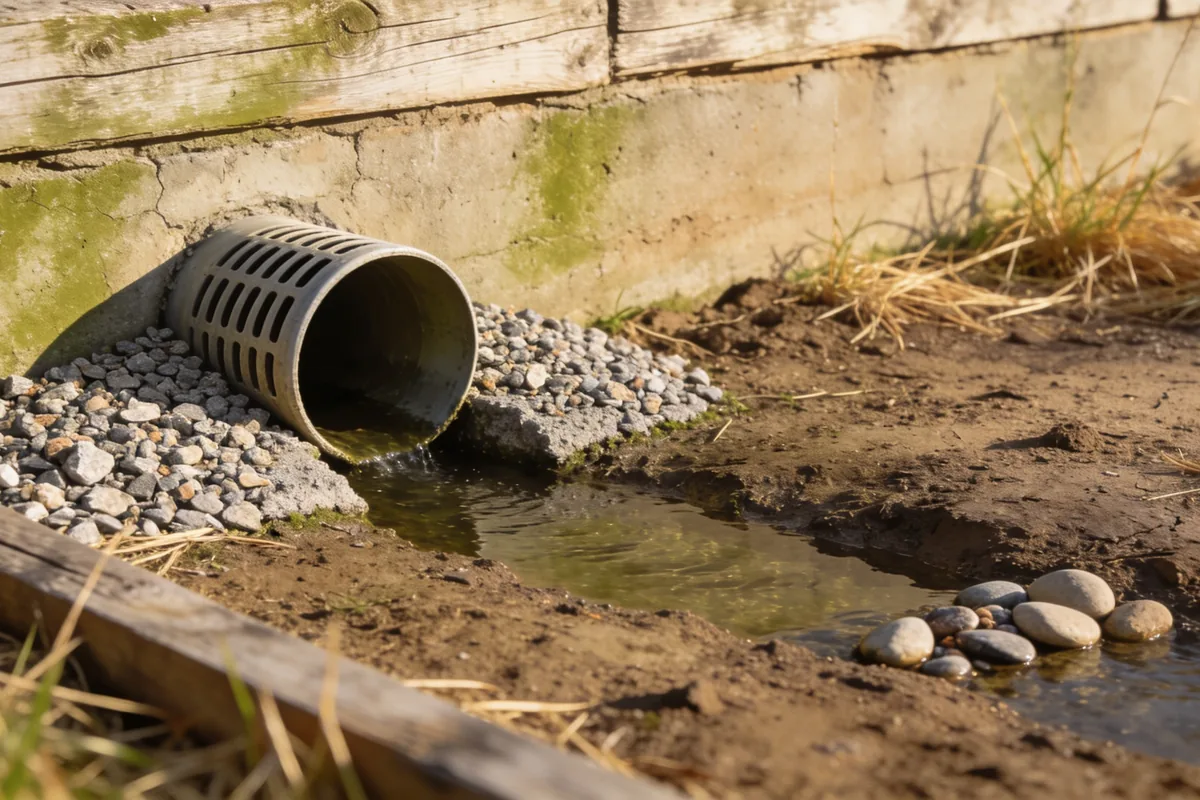
The parts that deal with it are unglamorous and they are all behind the face. A drainage layer immediately behind the wall, which is a zone of free-draining material rather than solid fill. A pipe at the bottom of that zone, to carry the water along rather than let it pool against the base. An outlet somewhere the water can actually get out, which is the part most easily left off because it is the part nobody will ever see. And the surface above the wall, because water that is shed away from the wall never becomes the wall’s problem.
Put together, that is the difference between a wall holding dry ground and a wall holding a sponge, and the price difference between the two is invisible at quoting time. Here is the sentence to keep from this section: all of that work disappears once the job is finished, which is exactly why it is the work that gets cut. Nobody is being asked to trust a contractor’s word on it, either. Ask to see where the water goes, and ask what the outlet will look like when the job is done. Those answers are plain, and they are the ones you will want in three years when the ground is behaving badly.

The footing, and what is holding the wall up
The second invisible half is the base, and it matters for the same reason: nobody sees it again.
The footing is what transfers the load the wall is carrying into ground that can take it. If the ground underneath has been disturbed, softened, or was never firm in the first place, the wall moves regardless of how well the wall itself was built. Two silent problems turn up here again and again. Soil that was loose when it was placed and has settled since, which is why a wall can look right for a year and wrong at year three. And ground that behaves differently when it is wet, which is why trouble often shows up after a soaking rather than gradually. The site’s how to prep your site for a smooth concrete pour makes the same point about the ground under a slab, and it is the same principle at work.
The practical version: on a slope, the question to ask is not “how high” but “what is under the bottom of this”. A competent contractor will want to establish that before quoting rather than after, because it is the one thing that decides whether an apparently identical wall is simple or not.
What moving looks like, and what to ignore
A reader who is now worried about their own wall needs a way to judge what they are looking at, so here is one, without pretending it is a diagnosis.
Worth taking seriously: the wall leaning as a whole rather than a single section. A run of cracks that keeps widening or lengthening. The ground behind the wall dropping away from the top of it. Water arriving where there was never water before, or a drain that has stopped draining. And bulging, where the face of the wall has visibly moved out in the middle.
Often harmless: a crack in the render, a bit of surface scaling on a masonry face, a patch of damp after a wet week. Those are the wall’s surface behaving like a surface.
Two of the serious signs together is the point at which to stop judging it from the house. Nobody can diagnose a wall from a photograph, this one included. What to have ready when somebody comes to look: photographs from a few angles, the story of when you first noticed it, what the ground around it has been doing, and any recent work nearby that might have changed how water moves. Say what you have noticed in your own words, too; the timeline matters more than the vocabulary.
Why the cheapest quote is often the most expensive one
Two quotes for the same wall can differ in price and look identical on paper, because the things that distinguish them are the things that get buried.
Three questions separate them. What is going behind the wall, and how is it drained? Where does the water exit, and what will that look like when the job is finished? What is the ground under the wall being prepared to sit on, and who is deciding that? If a quote cannot answer those, the price is for the visible half only, and the visible half is the cheap half. A quote that answers all three before being asked is a good sign in itself.
There is a structural point underneath all of this, and it is worth a reader’s attention before the first hole is dug. A wall, a fence and a driveway on a slope are one system rather than three projects. The wall holds the ground the driveway runs beside and the fence stands on, and all three shed water onto each other, so quoting them separately, without anyone looking at how they interact, is how a household ends up paying twice for one problem. That whole-slope view is the work VK Civil, a Melbourne civil contractor that does earthworks, drainage and retaining walls does. It is also the honest reason to slow down before accepting a quote that treats the wall alone. The same principle, of looking at a built thing’s whole system rather than its visible face, is what the site’s the key qualities that define long-lasting roofing materials argues about roofs.
The five questions before anyone digs
The compressed version, to keep at hand when the quotes arrive.
What is happening behind the wall, and how is it drained? Where does the water come out, and what will it look like when the job is finished? What is the ground under the wall, and who is deciding that? Does this wall have to work with the fence, the driveway or the slope above it? And who is coming back if it moves?
Those five are not technical questions, and that is the point of them. Anybody competent can answer them plainly, and anybody who cannot has just told you something useful. They travel well, too: the same five work on a garden wall, a driveway edge and a boundary alike. You are not buying a wall. You are buying the ground behind it staying where it is, and the wall is only how you tell.
Sources consulted: Geoscience Australia landscape and soil information; Bureau of Meteorology climate information.