


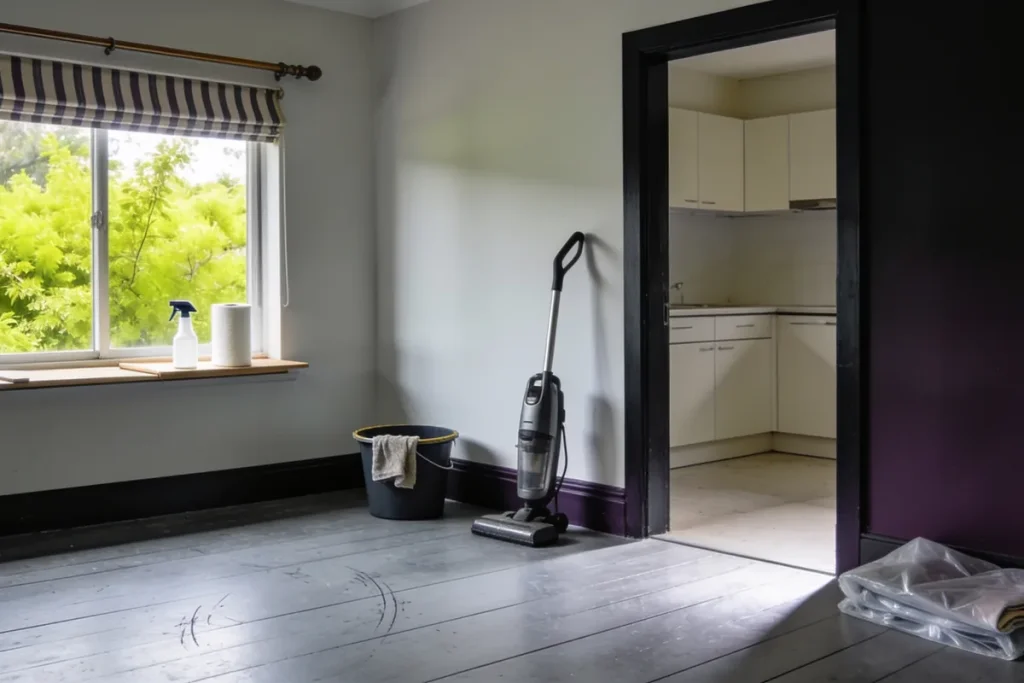
- What you are obliged to leave is a reasonably clean property, judged against how it was when you moved in, with fair wear and tear allowed for.
- A professional clean cannot be required of every renter. It can only be required when two specific things are both true.
- It is not up to the agent to decide whether something is clean enough.
- Most bond claims come from the same handful of places. Two of them deserve your time, and the rest can be left alone.
- The two things worth doing are the oven and the carpets. The one thing worth having is a dated photograph of everything.
The internet is full of cleaning companies willing to sell you a bond-back clean. Very few of them will tell you what your agreement actually requires, and there is a reason for that. The rules are more generous to renters than the industry’s marketing suggests, and the gap between the two is the difference between a weekend of hard work and paying for work you did not have to buy. What follows sets out the Victorian position, because the rules are state-based. Check your own state’s guidance if you are reading this from somewhere else. The widget above turns the room-by-room work into a list you can tick off.
The vacate clean, room by room
0 of 18Work down it in this order and the long jobs get done while you still have time. Read your condition report before you start, not after, and photograph as you go.
General information, not legal advice. What you are obliged to leave the property in depends on your agreement and on the condition report from the start of your tenancy. Check your own agreement, and get advice if a claim does not look right.
A professional clean cannot be required of every renter. Ask which part of your agreement applies before you pay for one.
What the obligation actually is
When you move out, the obligation is to leave the property in a reasonably clean condition, judged against how it was when you moved in, with fair wear and tear allowed for. That is the whole test. It is not a standard of spotlessness, and it is not what an advertisement looks like.
The corollary is the part worth reading twice. What counts as reasonably clean depends on how long you lived there and what state the place was in when you arrived. A renter who took on a property with a marked carpet and a tired oven is not obliged to hand it back better than they found it. The working guide, and the one to hold on to through the whole of this article, is simple: leave it as you found it, minus the wear and tear that ordinary living causes.
That single idea reorganises the entire job. It means the condition report from the start of your tenancy is not paperwork from three years ago. It is the document every later question gets answered against, and it should be the first thing you find before you clean anything.
Two consequences follow. The version of the test that surprises people is the one about time: a renter of eight years is not expected to hand the property back in the condition a renter of eight weeks is, and the report is where that difference lives. Fair wear and tear exists for the same reason: marks made by living somewhere are not damage.
When a professional clean can actually be required
This is the section no page selling you a clean will write, so here it is plainly. For agreements that started from 29 March 2021, a professional clean can be required of you only when two things are both true.
The first is that the property was professionally cleaned immediately before you moved in, and you were told about it at the time. Not suspected. Told.
The second is that a professional clean is genuinely needed to bring the property back to the condition it was in at the start of the tenancy, once fair wear and tear is allowed for.
If either of those is missing, no professional clean can be required of you. And if your agreement started before March 2021, your position is stronger again: an insistence on professional or steam cleaning does not stand up if the property is already reasonably clean.
Now the part that keeps this honest. None of the above means a professional clean is a waste of money. It means it is a choice. A renter who is short on time, or who is handing back a property that was spotless on day one, may reasonably decide the money is well spent. Both things are true at once: the requirement is conditional, and the service can still be worth buying of your own accord. If somebody tells you the clean is required, ask which of the two conditions applies, and ask for the answer in writing if it comes to that.
The first condition is a fact you can check. If the property was professionally cleaned before you moved in, that is usually recorded somewhere, and the moment to find the record is before the last week of the tenancy rather than after. If you cannot find it, ask, because the answer decides whether the second condition even comes into play. The test is not whether the agent wants the clean. It is whether both facts are true.
Who decides, and what to do when you disagree
Start with the sentence that gets mislaid in every moving-out panic. It is not up to the agent to decide that something is not clean enough.
Here is the actual shape of it. There is an inspection. There is a comparison against the condition report from the start of the tenancy. There is an opportunity to go back and fix something rather than have it deducted, which is a route renters forget they have. If agreement still cannot be reached, there is the bond claim process, and behind that a dispute route that exists for exactly this kind of disagreement. The detail belongs to your own circumstances, so this is where general information stops and advice begins.
Two habits decide most of these arguments, and both take minutes. Photograph everything, with dates, before and after the clean. And attend the final inspection if you can, because a conversation held on site is worth several by message afterwards.
One more line for the folder. A claim is a claim, not a bill. It is answerable, and it is not final until it has been tested.
The sequence matters more than it looks, because it gives you a window to fix rather than to argue. A scuffed wall you can clean is a deduction you do not have to contest, and going back to do it costs an afternoon rather than a hearing.
Where bond deductions actually come from
Bond claims cluster around the same places, so start your effort there and stop worrying about the rest.
Carpets come first, because stains and odours are the most common claim and the one with the most grey area. The difference between a clean and a replacement usually comes down to the size and type of the mark rather than the age of the carpet, and the site’s how often should you deep clean your carpets? a family guide to a healthier home covers the care side of the same story.
The oven is the single most-cited appliance, and the one most renters have never cleaned properly. It is also one of the two places where effort genuinely changes the outcome.
Then walls, skirtings and light switches, where marks, scuffs and the residue around handles collect. The bathroom, where the claims are shower screen scale, mould in the silicone, the toilet and the vanity trap. And outside: the balcony, the courtyard, the garage, and anything you have left behind.
One distinction runs under the whole list. Fair wear and tear is not damage, and damage is what can be claimed. A door that scuffed the paint over years of ordinary use, a hallway carpet worn thin by feet, a benchtop faded by sunlight: those are wear. A burn, a stain, a hole: those are damage. Read the claim list with that distinction in hand and several items fall away on their own.
Two quieter categories are worth a mention so they do not surprise you. Blinds, windows and tracks are claimed less often, and they follow the same rule as everything else: marks are claims, ordinary wear is not. Outdoor claims tend to be about what was left behind rather than what was dirty, which is the easiest category of all to close out before the inspection.
What you can genuinely skip
This section is the reason the article can be trusted, so here it is without hedging.
Do not repaint. Do not shampoo a carpet that is not marked, beyond a normal vacuum and a spot clean, and check the condition report before you decide even that. Do not clean inside the roof space or behind the fridge unless it is on the report. And do not pay for a service you were not obliged to buy just because somebody said the words.
The two things you do not skip are the oven and the carpets. Together they account for the majority of disagreements, and they are where an extra hour is worth more than an extra product. Everything between those poles is judgement, and the judgement is easier when you have read the condition report rather than guessing from memory.
Skipping is not neglecting, either. The list above is short because it is built from what actually gets claimed, not from what sounds thorough. Repainting is worth dwelling on for a sentence, because it is the most common unnecessary spend of the lot. The paint was already there when you arrived, and its ordinary ageing belongs to the property rather than to your tenancy. Touching up is a different question from repainting, and it is worth asking about rather than assuming in either direction.
The practical version of all of it: do the work over a week rather than in one panic the night before the keys go back. A rushed clean on no sleep is how small misses become deductions.
If you are paying someone
Read this part the way you read the rest of the article, which is with the two conditions in section three in hand.
Ask what is included in the price and what is not. Ask whether the oven and the carpets are inside it, because they are the two jobs that matter. Ask whether they re-attend if the agent raises something afterwards, and for how long that offer stands. Ask whether they work from your condition report or from a generic list, because a cleaner working from your actual report is doing a different job. And ask what happens if the property is not empty by the time they arrive.
One sentence the trade has earned. A cleaner who has done your building before is worth more than a cheaper one who has not, because they already know what that particular agent looks at. If you are comparing two quotes, compare the lists rather than the totals, because the cheaper quote that excludes the oven is not cheaper. It is a different job. Some readers will decide the whole list is better handed over. That is a normal outcome and the service a residential and commercial cleaning company working across Melbourne’s west provides, and the questions above are the ones to ask of it. The site’s restaurant deep cleaning: the 10 areas that need more than a daily wipe-down shows what the professional version of this work covers on the commercial side, and the site’s 5 signs your medical or dental clinic needs professional cleaning is the same idea for premises where the stakes run higher again.
The week before you hand the keys back
The widget above is this section in working form, so keep it short here. Work room by room. Do the oven and the carpets first, because they take the longest and matter the most. Photograph everything with dates. Find the condition report and read it before you start rather than after. Book the final inspection for a time you can attend. And when it is done, hand the keys back and lodge the bond claim without letting it drift.
None of it is difficult. The list is short because the obligation is short.
The bond is not won on how hard you scrub. It is won on what the property looked like the day you moved in.
General information, not legal advice. What you are obliged to leave the property in depends on your agreement and on the condition report from the start of your tenancy. Check your own agreement, and get advice if a claim does not look right.
Sources consulted: Tenants Victoria moving out information; Residential Tenancies Act 1997 (Vic).