


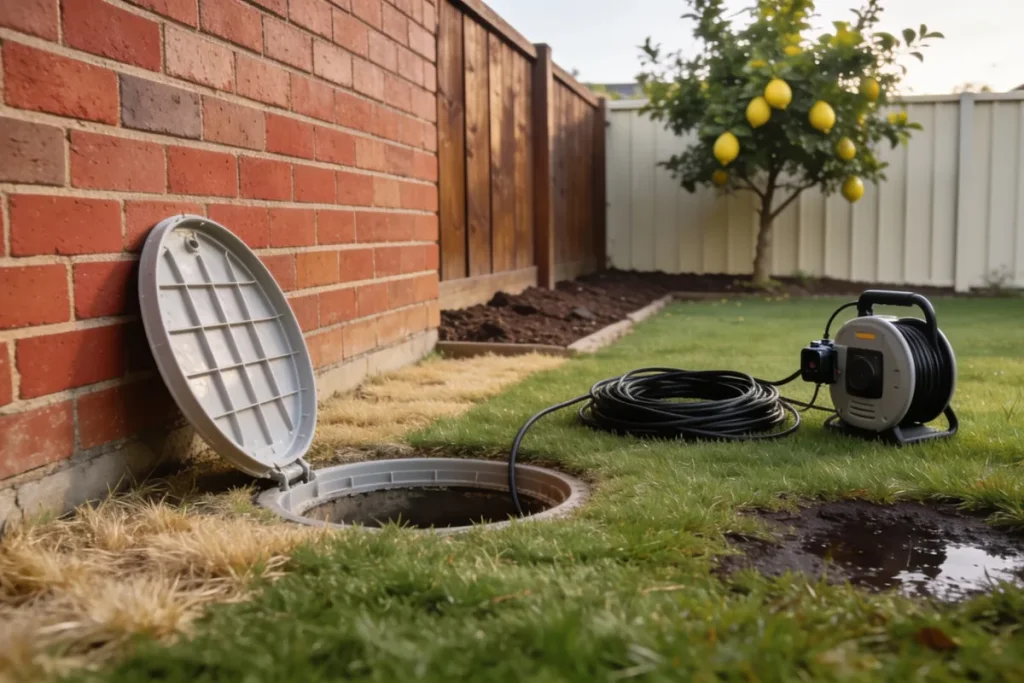
- A drain camera turns a guess into a picture. A picture is only worth paying for when it changes what happens next.
- What it sees: the inside of the pipe, its joints, its fall, and what has grown into it or broken. What it cannot see: anything outside the pipe, and anything beyond a blockage it cannot pass.
- A camera is usually the cheapest next step in four situations: a blockage that keeps coming back, a line that is about to attract serious money, a property that is about to change hands, and a problem nobody has been able to find.
- It is usually money for peace of mind when a first blockage cleared and stayed cleared, when the trouble sits at a single fixture, or when the decision about the line has already been made.
- The report is worth more than the footage: where the problem is, what it is in plain words, how serious it is, and what the options are, in writing.
A drain camera turns a guess into a picture, and a picture is only useful if it changes what you do next. The inspection is not a ritual that every drain deserves, and it is not an upsell to be refused on principle either. It is a diagnostic purchase, and like any purchase it makes sense in some situations and not in others. The point of an inspection is not the footage. It is the decision the footage lets you make.
Do you need a drain camera?
Five questions. The answer at the end is the same one this article gives in prose, and it is not always "yes".
If this does not load: if the same blockage keeps coming back, if you are about to spend money on the line, or if nobody can find the cause, a camera is usually the next step. If a drain has blocked once, cleared and stayed clear, or the problem is one slow fixture, it usually is not.
- Has this drain blocked more than once in the last couple of years? (Yes / No / Not sure)
- Has anything already been dug up, replaced or relined on this line recently? (Yes / No / Not sure)
- Is the problem at one fixture, like a single slow basin or a running toilet? (Yes / No)
- Are you about to spend money on this line, or buy or sell the property? (Yes / No)
- Has a plumber already looked and could not work out the cause from the outside? (Yes / No)
General guidance only. It is not a diagnosis of your property. Confirm what is happening on your line with a licensed plumber.
No costs, no prices and no equipment details are given here. The answer is built from your answers alone.
What a drain camera actually is
A drain camera is a flexible rod with a camera head on the end, pushed through an inspection opening or down the drain itself. The operator watches the footage live, the run is recorded, and a report is written from what the recording shows.
What matters is what the operator is looking at, because that is what the report is built from. The camera travels the inside wall of the pipe and passes every joint between sections. It shows the fall of the line, whether the pipe drops the way it should as it runs away from the house. It finds roots through a joint, cracks, sections that have shifted out of alignment, and the build-up of grease or scale that narrows a pipe over years. And it shows what the water is doing: running away freely, or pooling.
One distinction is worth fixing early, because it explains most disagreements about price. When people say “a camera”, they can mean either of two jobs: a quick look as part of clearing a blockage, or a full survey of a line from end to end. They are different pieces of work. A householder quoted for one and picturing the other will find the difference in what the report covers, and it is a fair question to ask which is on the quote.
When a camera is genuinely the cheapest next step
Four situations make the camera the sensible purchase, and each shares the same logic: the camera converts a repeat visit into a repair.
The blockage that keeps coming back. Clearing a drain is a service that works until it does not. If the same line has blocked repeatedly, each clearance is money spent on the symptom, and the pattern will continue until somebody looks inside the pipe. The camera is how the repeat visits stop.
The line you are about to spend serious money on. Nobody should sign off on relining or excavation without knowing what is actually wrong along the length of the pipe. A reline is designed from a survey, and a reline designed from a guess is a guess with a liner in it. The inspection is the cheapest component of a big job and the one that decides whether the big job is the right one.
The property you are about to buy. Underground drains are the one substantial part of a house that sits out of sight and out of reach. A buyer who asks before settlement is asking at the only moment when the answer can still change the terms.
The problem nobody has been able to find. A smell that comes and goes, a damp patch with no obvious source, a drain that has been slow for months and has already been looked at from the outside more than once. At that point, the camera is not one option among many; it is the only step that produces new information.
When it is not worth it
A first blockage that clears and stays cleared. Most of them do. A camera on the first blockage is usually a bill for peace of mind rather than a piece of information, and peace of mind is not nothing, but it is honest to call it that.
A problem that is obviously at a fixture. One slow basin, a running toilet, a trap that needs cleaning: these are not buried pipe problems, and the camera will not see them, because it is not looking there. Fix the fixture first. If the line still misbehaves, the conversation changes.
A line that has just been surveyed. If there is footage from a recent inspection, read that before paying for another one. Footage outlives the visit that produced it, whatever the ownership of the house has done in the meantime.
When the decision has already been made. If the plan is to excavate and replace regardless of what a camera finds, then the camera is not informing anything, and the money is better spent on the work.
And the line that belongs beside all four of these: if the person quoting you cannot tell you what they expect to find, and what would change their recommendation, then the camera is being sold rather than used.
The limits, stated properly
A camera is a specific tool with specific edges, and knowing them prevents an expensive disappointment.
It sees the inside of the pipe and nothing outside it. A leak escaping into the surrounding soil can be invisible to the camera even while it is happening, which is why an inspection is one input among several rather than a verdict on its own.
It cannot see past a collapse or a hard blockage. Whatever lies beyond the point where the camera stops is unknown until the obstruction is cleared, and a report should say so rather than imply the whole line has been viewed.
It cannot tell you how long a pipe will last. It reports what is there on the day, and extrapolating from that to a lifespan is guesswork dressed as data.
It is not a substitute for the other kinds of testing a property might need, and it says nothing about the water supply side of the house, which is a different system with different failure modes.
What the report should tell you
The footage is the raw material; the report is the product, and almost nobody explains what a useful one contains.
Where in the line the issue is, described from a known starting point rather than a raw number nobody can check. What the issue is, in plain words rather than trade vocabulary. How serious it is, because a root intrusion that is cut back once a year is a different situation from a displaced joint under a driveway. And what the options are, with the reasoning for each, so the choice that follows is a choice rather than an instruction.
Three practical asks. The footage itself, in a form a second plumber could watch, because a record that travels is worth more than a memory of a screen. A note of anything the camera could not see past. And a sentence on what to watch for if you choose to do nothing yet, because doing nothing is legitimate when the report supports it.
A report that recommends work is normal, including from the business that performed the inspection, and that does not make it dishonest. The reader’s protection is not suspicion. It is the fact that the footage exists, and that it stays with the property.
After the camera: the three outcomes
Every inspection ends in one of three places, and knowing them in advance makes the report easier to read.
Nothing that needs work now. This is a real outcome and the reader should expect to hear it when it is true. The useful question afterwards is what to keep an eye on.
A blockage or build-up that can be cleared. Cutting, jetting or cleaning, followed by a second look at the same line, because a clean pipe is the only proof that the cleaning worked. A before and after pair of recordings is the difference between a service delivered and a service claimed.
A defect that cleaning will not fix. A crack, a root-damaged section, a displaced joint, a collapse. This is where the conversation moves to repair, relining or replacement, and the site already covers that ground properly: the site’s 7 signs your pipes need relining now sets out the symptoms, and the site’s pipe relining made simple: a step-by-step guide follows the work itself. The point here is narrower: a reline should be the conclusion of a survey, not a substitute for one.
Who does the work
The DIY question deserves a straight answer rather than a dodge. Hiring a camera is possible, and some householders do it. The honest position is that the camera is not the hard part. Reading what it shows is the hard part: knowing which of the things on the screen matters, what it implies, and what to do about it. The work that follows from the footage is a plumbing and drainage job, and in Victoria that work is registered work.
That leaves a householder with one useful check, asked before anyone starts: are you registered for this work? Ask it plainly, and ask to see the registration rather than hear about it, because a person who is registered for the work will answer the question as a matter of routine. The same rule protects the first visit as much as the tenth. It is the kind of question a Werribee plumber who runs CCTV drain inspections and pipe relining answers without needing to be asked twice, and the site’s keeping homes running smoothly: the importance of reliable plumbing in Werribee covers the local side of keeping those systems in order.
What the footage should tell you
The compressed version, for a householder holding a quote.
The camera is worth booking when the same problem has come back, when a large spend is being decided, when a property is changing hands, or when nobody has been able to find the cause. It is not worth booking for a first blockage that cleared, for a problem that sits at one fixture, or when the decision has already been made without it.
The thing being bought is not a video. It is the ability to stop guessing about something buried under the house, and that is worth exactly as much as the decision it improves.
Sources consulted: Victorian Building Authority plumbing licensing information.