


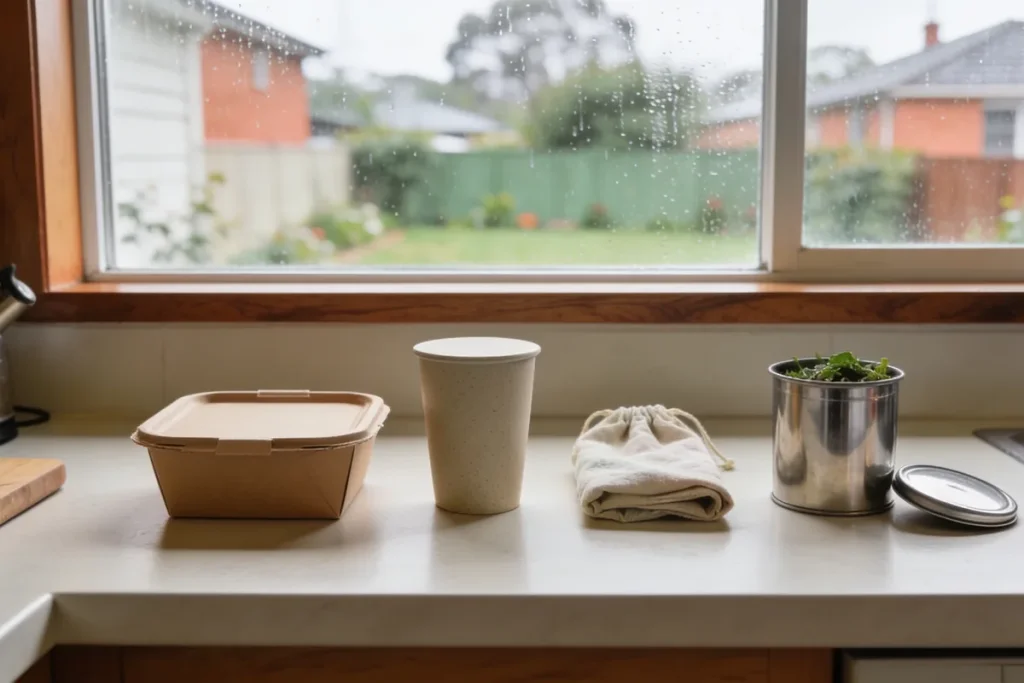
- Four words on packaging are not synonyms: degradable, biodegradable, compostable and bio-based. Only one of them points at something testable.
- A claim about a material is not a claim about a bin. The conditions that break an item down belong to the facility, not to your kitchen shelf.
- A bare “degradable” claim is treated by the consumer regulator as misleading. “Biodegradable” says microbes can break the material down, and nothing about when, where, or into what.
- Compostable is the strongest of the claims, because it names a process and a timeframe. It still comes with an asterisk.
- The useful question is not whether one item is better than another. It is better under what conditions, and whether you have them.
The container went into the bin, and then it came back out again. It was a takeaway container with the word compostable on the lid, and the kitchen it had arrived in held three bins: general waste, recycling, and a small caddy for food scraps. It did not quite belong in any of them. That moment at the bins, holding a container and trying to work out which one deserves it, is not a failure of your habits. It is the label failing to be readable. The fix is smaller than it looks: four words, what separates them, and one honest question.
The four words, separated
Degradable is the emptiest of the four. It has no defined meaning and no timescale attached, so almost any plastic could claim it, given enough decades and enough sunlight. The consumer regulator treats an unqualified degradable claim as misleading, and that position is easier to understand once you notice what the word is doing: it promises a process without naming one. A promise that cannot be checked is not information. It is decoration.
Biodegradable is the next step up, and it means roughly what it says: microbes can break the material down. What it does not say is how long the process takes, where it can happen, or what it turns into. The regulator warns that the word conveys a range of meanings to consumers and should not be used indiscriminately, which is a polite way of saying it has been used indiscriminately for years. A biodegradable item in a backyard, a landfill and a compost facility is three different experiments, and only one of them might end well.
Compostable is the strongest claim of the four, because it specifies the process and the timeframe. Where it is used properly, it points at a standard: the item will break down within a set time, under set conditions, into set things. That is what makes it the one word in the set that can be tested and certified rather than simply printed.
Bio-based is the odd one out, because it answers a different question entirely. It describes where the carbon in the material came from, and says nothing about what happens to the object afterwards. A bio-based item can be functionally identical to a conventional plastic one: same strength, same durability, same persistence in a bin. Made from plants and breaks down are two separate ideas, and packaging marketing is at its slipperiest when the first quietly stands in for the second.
One more piece of background explains why these words are on the shelf at all: businesses making these claims are expected to be able to substantiate them and to qualify them, which sounds like a low bar until you notice how often a label relies on the reader not asking. A claim with a qualification attached is doing its job. A claim without one is asking you to assume the best.
The site’s glass vs plastic bottles: which is better for you and the planet runs that same separation on a single product, if you want to see the two questions kept apart in practice.
The rules themselves add a layer over all of it, and that layer is state-shaped. Bans on single-use items have arrived state by state and territory by territory, each on its own timeline and with its own item list, so “banned in Australia” is almost always shorthand for banned where you live.
Why “compostable” is the only one worth trusting, and why even that has an asterisk
Compostable earns its standing because it is a claim about a process rather than about an ingredient. An item certified as compostable has been assessed against conditions: a certain temperature, a certain timescale, a certain result. That is a testable promise, and testable promises are rare on a shelf. It is also the one word whose meaning a reader can check in the hand: a label either names the conditions the item was tested against, or it leaves the conditions unstated, and the difference between those two labels is where the trust sits.
The asterisk is the part the packaging never mentions, and it is the part the reader of this article probably suspects already. The conditions in the standard belong to a facility, not to your kitchen. Industrial composting runs on heat, volume and a microbial population that a garden compost bin does not reproduce, and a kerbside garden organics bin is not automatically the same environment again. Some products are certified for home composting; most are not, and the two certifications are not interchangeable. A home compost bin is its own small climate, and an item built for an industrial line may sit in it for months without doing much of anything.
One sentence is worth keeping from all of that. A compostable cup that goes into the general waste bin behaves exactly like waste. That is a fact about the bin, not about the cup, which is why the next section matters more than the label does.
The thing the reader is actually asking
Nothing on a package tells you where the package is going, so here is the disposal picture in this country, in four honest parts.
General waste goes to landfill. In landfill, a compostable item may break down slowly or not at all within any useful timeframe, because the conditions that would make it compostable are the ones landfill does not provide.
The commingled recycling stream is not built for plant-based plastics. A compostable item dropped into the recycling bin is not recycled material; at best it is sorted out, and at worst it is contamination in a load that was otherwise fine.
Garden organics collection exists in some council areas and accepts some certified items and not others. The rules are set locally, so a container that is welcome in one council’s green bin may be excluded in the next suburb over.
Home composting takes a narrower set again, and that is fine. A backyard bin is a small system with its own rules, and it works best with the things it was built for.
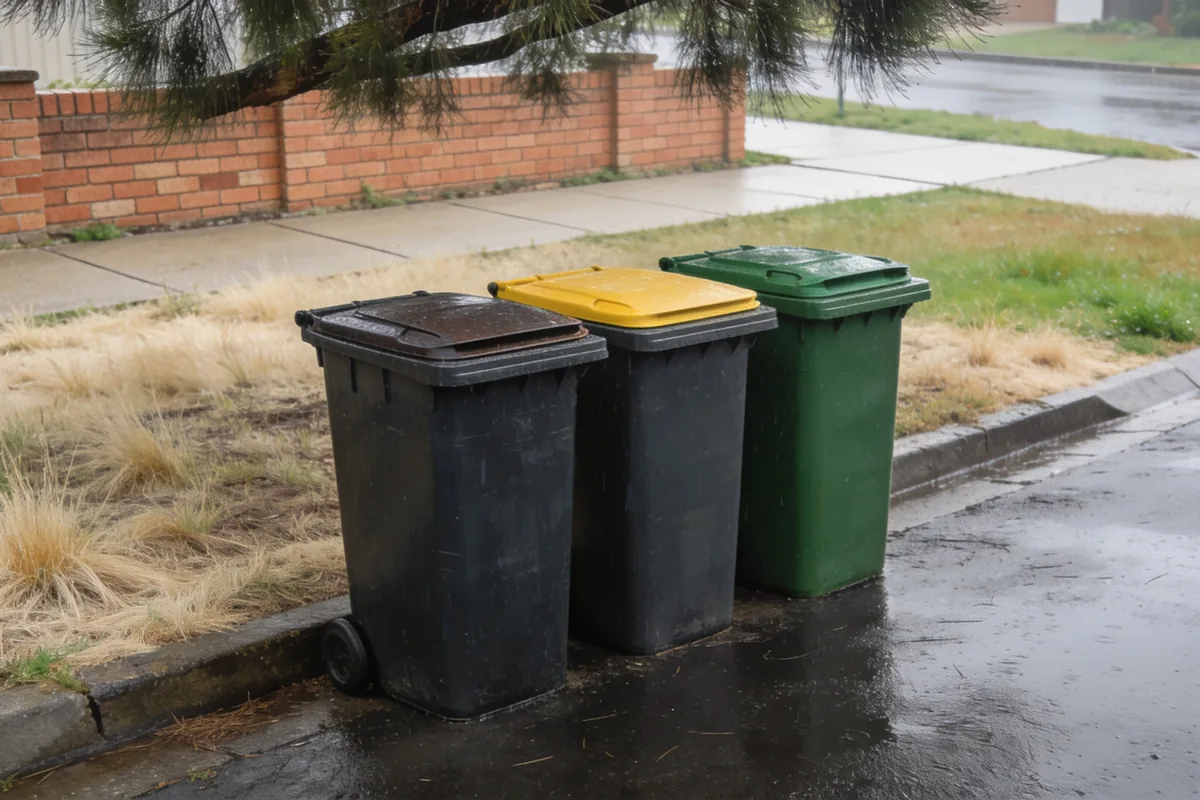

The conclusion to draw is not that the whole thing is a con, and it is not that labels are useless either. The item you already own is going to end up somewhere, and the label does not get to choose where. Your council does. That is why the most useful next step after reading a package is a look at your own council’s waste pages rather than another pass over the small print.
Part of the explanation for the shelf sits in a national target. The Australian Government has set a target for all packaging to be recyclable, reusable or compostable, and that target changed a great deal of packaging. It also made the shelf confusing, because many products changed their labels before the collection system caught up, so the promise arrived ahead of anywhere to keep it. That is worth remembering when a bin does not behave the way a label implied. It is a mismatch between two systems, not a failure on your part.
Australian households have already had one lesson in what happens when a collection system and a packaging promise fall out of step. The supermarket soft-plastics collection that many of us had built our habits around stopped, and no amount of good faith at the bin changed that. The lesson is not that the effort was wasted. It is that the promise and the system have to line up, and right now, for a lot of compostable packaging, they still do not.
The uncomfortable part: less is still less
One thing survives all the label confusion, and it is worth saying before the shelf advice, because the shelf advice is the weaker of the two levers. Reusable beats single-use regardless of what either is made of. A cloth bag you already own beats a compostable one you buy for the occasion. A paper bag that has already been used three times is doing more work than a plant-fibre one that has to be manufactured, shipped and binned.
That is not an argument against plants. A product made from plants still used land, water and fuel to grow, make and move, and the honest reading of the shelf is that material choice is a smaller lever than whether you needed the item at all. The site’s going plastic free at home: the swaps that actually stick is the practical version of that point, built around the swaps that last. And there is a test that costs nothing: wait. A reusable alternative you already own, used one more time, beats almost any purchase made on the strength of a word on a package.
There is a counterweight, and it is real. For some applications there is no reusable option yet, or not one a person can carry. Where a product genuinely needs to be single-use, a certified compostable item in a council that actually processes it is an improvement on a conventional one, and pretending otherwise would be as dishonest as the marketing this article is picking apart. The site’s real vs artificial plants: which is actually better for the environment makes a similar check on a different product, and it lands in a similar place: it depends on the conditions, and the conditions are usually local.
Both things are true at once. Less is still less. And less is not nothing.
What to do at the shelf
Four questions, and none of them needs a chemistry degree.
Does the label name a standard or a certification scheme, or does it simply use the word? A named standard is a claim with a document behind it, which is a different thing from a decision by whoever wrote the label. A bare word is a mood.
Does it say compostable or biodegradable? If it says biodegradable, is there any qualification at all about time, place or conditions? An unqualified biodegradable claim is doing the same work as an unqualified degradable one, with better manners.
Does it say industrial or home compostable? These are different claims with different destinations, and if the answer is industrial while your garden is not, you have learned something genuinely useful.
And the question that cuts through everything else: would I buy this if the label said nothing?
The packaging tells you how to get rid of one item. The choice of whether to buy it is the bigger lever, and it is still yours. When the four questions have done their work and you still want somewhere to look, an Australian directory of plastic-free and non-toxic alternatives is built for exactly that search. The site’s rechargeable vs single-use batteries: do they save money, and how do you recycle them asks the same end-of-life question about something that has been sitting in a drawer, which is the other half of this habit.
How to read a label without a chemistry degree
Four words, one glance each. Degradable: meaningless without a timescale. Biodegradable: microbes will get to it, eventually, somewhere. Compostable: a real process, with conditions attached. Bio-based: about the source, not the destination.
Then carry three things to the shelf, because they decide most of it. The word doing the work, the qualification that is missing, and the bin you actually have at home. A label that survives all three is worth trusting. One that does not was never answering your question in the first place.
Being sceptical of a claim is not the same as giving up on the change. The packaging aisle is confusing because it is doing two jobs at once: telling you something about the product, and telling you something about the company. You are reading the labels. That already puts you ahead of most of the aisle.
Packaging language is young and still moving, and some of these words will mean something tighter in a few years than they do today. Reading them carefully does not have to wait for that.
Sources consulted: Clean Up Australia compostable and biodegradable plastics information; Department of Climate Change, Energy, the Environment and Water plastics and packaging.